Understanding the Extreme Heat of White Flames
How hot is white fire? White fire burns at temperatures between 1,300°C and 1,600°C (2,400°F to 2,900°F), making it one of the most intense flame colors. The exact temperature varies with brightness:
- Whiteish-tint flames: ~1,300°C (2,400°F)
- Bright white flames: ~1,400°C (2,600°F)
- Dazzling white flames: ~1,500-1,600°C (2,700-2,900°F)
When you see a fire, its color is a direct indicator of its temperature. While most people picture red or orange flames, white flames represent combustion at truly extreme levels. For homeowners, understanding what white flames mean helps explain the devastating damage left behind. White flames represent temperatures so extreme they can melt aluminum, shatter glass, and compromise the structural integrity of steel beams.
This guide explores the science behind flame colors, reveals exactly how hot white fire burns, and explains what these temperatures mean for your home. We’ll compare white flames to other colors, examine their destructive power, and discuss the harsh reality of restoration after such intense heat. As Daniel Cabrera, with 15 years of experience in real estate assessing over 275 fire-damaged properties, I’ve seen that when white flames are involved, the path to recovery is significantly more challenging.
The Science Behind Flame Color and Temperature
Why does a campfire glow orange while a gas stove burns blue? The colors in a flame reveal secrets about the fire’s temperature and efficiency. Understanding this science explains why white fire is so dangerous in a house fire.
Fire is a chemical reaction called combustion, where fuel (like wood or furniture) combines with oxygen to release heat and light. The color we see comes from two sources. The first is blackbody radiation: as an object gets hotter, it glows, shifting from red to orange, yellow, and eventually white. The second involves excited atoms releasing energy as particles of light called photons, which have different colors.
The efficiency of the fire plays a huge role. Incomplete combustion, caused by a lack of oxygen, creates cooler, soot-filled flames that glow yellow-orange. This is why a candle flame is yellow.
Complete combustion occurs with plenty of oxygen, resulting in a hotter, more efficient fire. With less soot, you see the light from excited gas molecules, which appear blue or white. In a house fire, a sudden rush of oxygen—from a broken window, for instance—can turn a smoldering fire into a white-hot inferno.
What Causes Different Colors in Flames?
While temperature is the main driver of flame color, the chemical composition of the burning material also contributes. This is how fireworks get their vibrant colors.
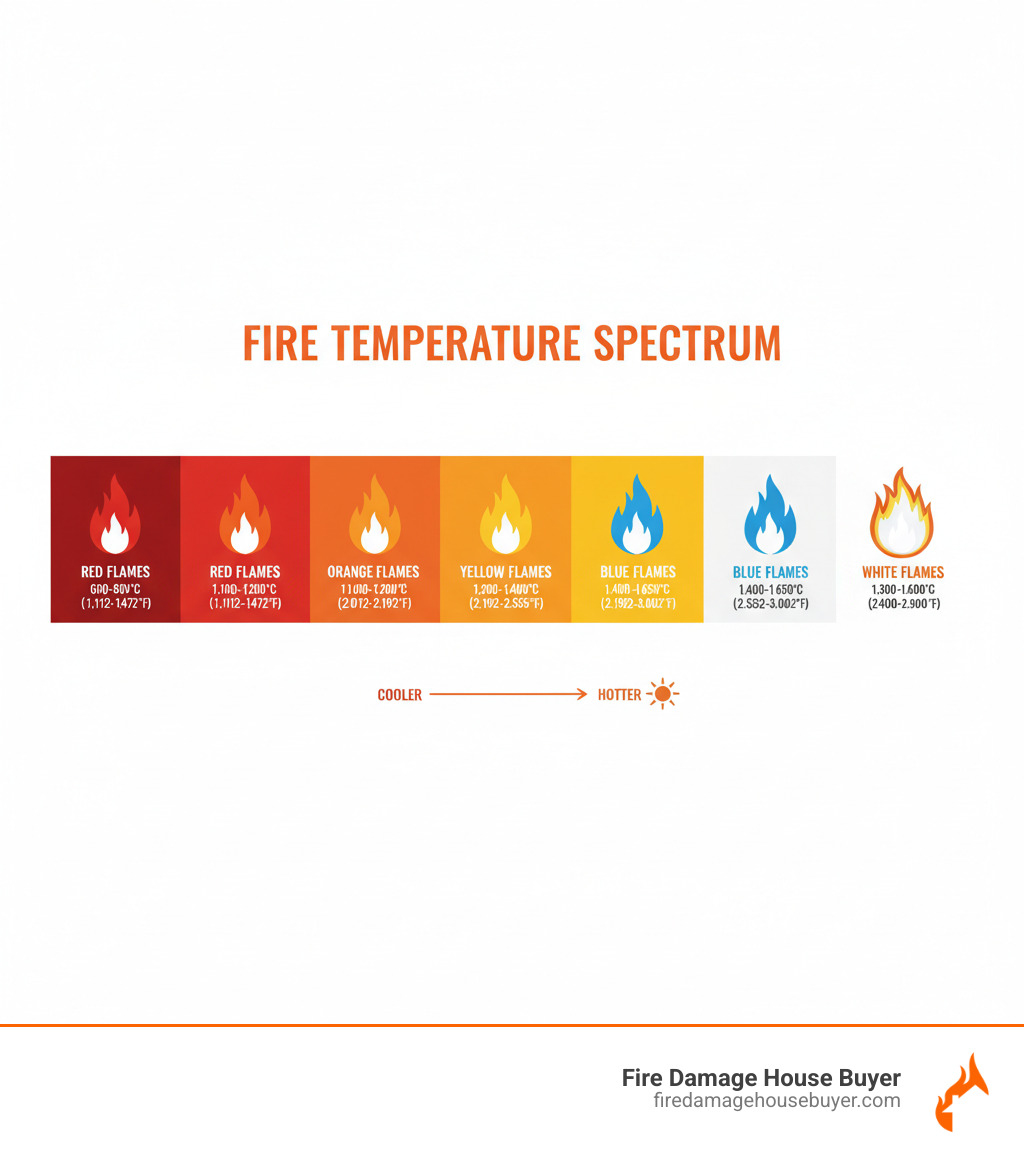
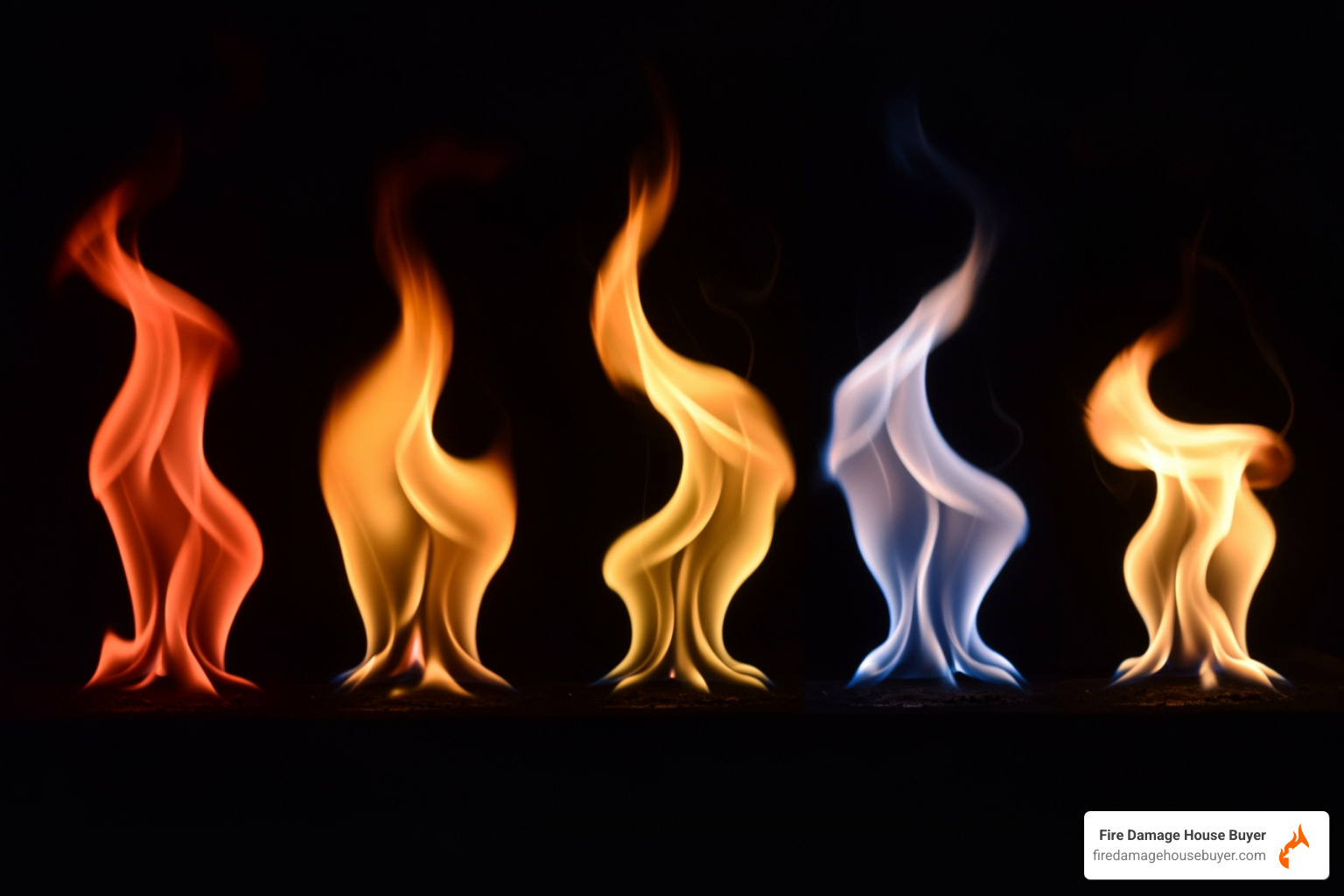
Temperature remains the primary factor. As heat increases, flames shift from red (coolest) to orange, yellow, and finally white and blue (hottest). This follows the principle of blackbody radiation.
However, certain elements emit specific colors when burned. For example, sodium produces a bright yellow flame, and copper burns with a blue-green hue, which you might see if copper pipes burn in a house fire. In a typical house fire, you see a complex mix of colors, but the temperature effect is dominant. When you see white flames, it means the fire is so hot it’s emitting light across the entire visible spectrum. This combination of all colors appears white and signals catastrophic temperatures.
How Hot is White Fire? A Temperature Comparison
So, how hot is white fire? White flames burn between 1,300°C and 1,600°C (2,400°F to 2,900°F). Some dazzling white flames can even reach 1,650°C (3,000°F). This is hot enough to melt aluminum and cause steel beams to lose their structural strength.
The exact temperature depends on the fuel source and oxygen availability. For example, burning magnesium creates a brilliant white flame that can reach over 2,000°C (3,600°F), according to ScienceDirect. When a fire has an optimal oxygen supply, combustion becomes more efficient, pushing temperatures into the white range. This is why a blowtorch is so much hotter than a candle.
If you’ve seen white flames in a house fire, you’re dealing with damage from some of the most extreme heat conditions possible, which dramatically increases restoration challenges and costs.
Flame Temperature Chart: Red, Orange, Blue, and White
To appreciate how hot white fire is, let’s compare it to other flame colors. Each color represents a different temperature range and combustion efficiency.
| Flame Color | Temperature Range (Celsius) | Temperature Range (Fahrenheit) | Combustion Efficiency |
|---|---|---|---|
| Red flames | 600–800°C | 1,112–1,472°F | Incomplete combustion |
| Orange/Yellow flames | 1,100–1,200°C | 2,012–2,192°F | Moderate combustion |
| Blue flames | 1,400–1,650°C | 2,552–3,002°F | Efficient combustion |
| White flames | 1,300–1,600°C | 2,400–2,900°F | Extremely hot, intense combustion |
As the table shows, red flames are the coolest, while blue and white flames represent the highest temperatures and most efficient combustion you’ll see in a residential fire.
Understanding Intensity: How Hot is White Fire at Different Levels?
Not all white flames are equal. The brightness indicates the intensity. Whiteish-tint flames are at the lower end, around 1,300°C (2,400°F). Bright white flames signal hotter combustion at about 1,400°C (2,600°F). The most intense are dazzling white flames, reaching 1,500°C to 1,600°C (2,700°F to 2,900°F). At these temperatures, even steel beams soften and lose their load-bearing capacity. The brighter the white, the higher the temperature and the more severe the damage, which is why many homeowners ultimately decide to Sell Fire Damaged House rather than face the overwhelming restoration.
What White Flames Reveal About a House Fire
Seeing white flames in a house fire is a sign of peak intensity and immediate, life-threatening danger. At temperatures between 1,300°C and 1,600°C (2,400°F to 2,900°F), white flames indicate several critical things: extremely high heat release, highly efficient combustion, a high oxygen supply (often from broken windows or breached walls), and an increased risk of flashover—the moment when all combustible surfaces in a room ignite simultaneously.
When a fire reaches this intensity, the destruction is often total. The home’s structural integrity is pushed beyond its limits, and what remains is frequently beyond salvage.
The Destructive Power of Extreme Heat on Your Home
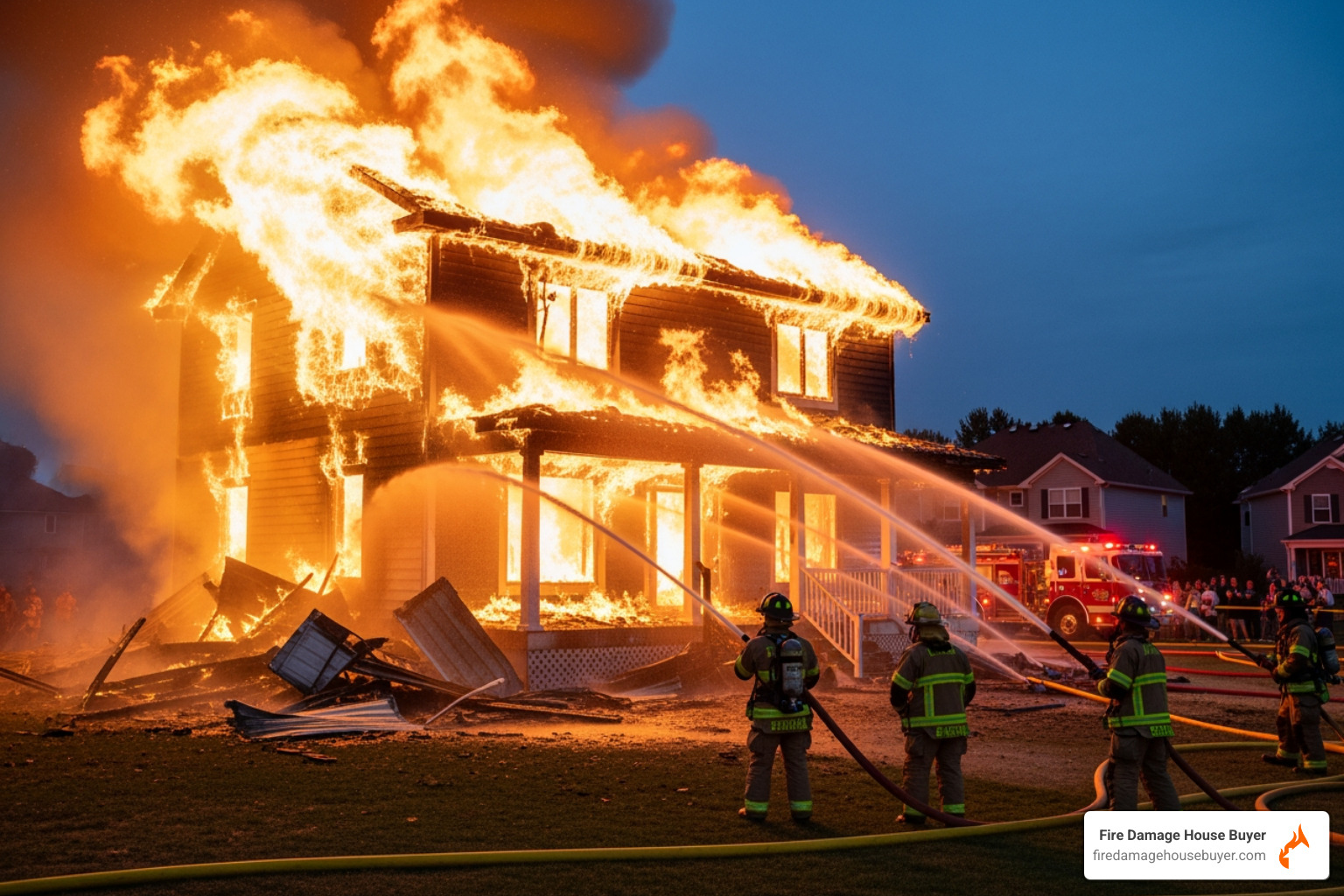
The temperatures of white flames are well above what most household materials can withstand. Glass shatters, aluminum siding and window frames melt (at 660°C / 1,220°F), and steel beams soften and lose their load-bearing capacity long before they melt, leading to structural collapse. Even the concrete foundation can be compromised through a process called spalling, where chunks explode off the surface, weakening the structure.
The result is severe structural compromise across every system. Walls buckle, roofs cave in, and entire sections of the house can be reduced to rubble. The scope of fire damage restoration and repair after such heat is overwhelming, with costs in states like California, Florida, and Texas often exceeding $200,000 to $500,000. The timeline can stretch from 6 to 18 months, a period of immense stress detailed in our house fire damage restoration guide.
Critical Safety Considerations for High-Temperature Fires
High-temperature fires, especially those with white flames, demand immediate evacuation. There is no time to hesitate.
- Rapid Fire Spread: Modern homes can become fully engulfed in flames in under five minutes. You may have as little as two minutes to escape from the moment a smoke alarm sounds.
- Flashover: This is when everything in a room ignites at once. White flames are a strong indicator that flashover is imminent or has already occurred.
- Lethal Temperatures: In a fire, heat stratifies. Air at eye level can reach 315°C (600°F) or higher, causing fatal respiratory burns. This is why you must crawl low under the smoke.
- Evacuate Immediately: If you see signs of a rapidly spreading fire, get out, stay out, and call 911 from a safe location. Do not stop for valuables or try to fight the fire.
- Have a Plan: A well-rehearsed fire safety plan with two escape routes from every room and an outdoor meeting point is essential. The Portland Fire Bureau offers excellent fire safety tips for creating one.
Understanding the financial impact is also crucial. Our guide on how to price a fire damaged house explains how severe heat damage affects property valuation and why many homeowners choose to Sell Fire Damaged House instead of attempting restoration.
Aftermath: The Challenge of Restoring a High-Heat Fire Damaged Home
Once the flames are out, the true devastation from a white fire becomes clear. Burning at 1,300°C to 1,600°C (2,400°F to 2,900°F), this intense heat causes damage that extends far beyond what’s visible.
Assessing the catastrophic damage is a sobering process. You’re not just looking at charred surfaces; you’re dealing with a fundamentally altered property. Warped structural components, from floor joists to roof trusses, may be on the verge of collapse. Steel beams can be bent and weakened, and even concrete foundations suffer from spalling, compromising the entire structure.
Your home’s vital systems are equally devastated. Compromised electrical and plumbing systems are the norm, requiring a complete gut and replacement. PVC pipes melt, and electrical wiring becomes a hidden hazard throughout the walls.
Beyond the fire, pervasive smoke and soot penetrate deep into porous materials like drywall and insulation, leaving a corrosive, toxic residue and an odor that’s nearly impossible to remove. This is compounded by water damage from firefighting efforts, which soaks everything and leads to rapid mold growth, adding another layer of hazard and expense.
The complexity of restoration after a severe fire is immense and requires a team of specialists, from structural engineers to environmental remediation experts. The timeline can stretch from months to over a year, all while you’re displaced from your home. The financial and emotional toll of rebuilding is often the breaking point. Restoration costs can easily exceed $300,000 to $500,000, often surpassing insurance coverage, as detailed in our fire damage insurance claims guide.
This overwhelming reality leads many homeowners to question whether they should rebuild or sell after house fire. For properties that have experienced the extreme temperatures of white fire, the dream of restoration can quickly become a financial and emotional nightmare.
Why Selling May Be the Best Solution
When facing the devastation caused by flames that burned white-hot, the idea of restoration can feel impossible. The stress of dealing with insurance adjusters, unreliable contractors, and endless delays is overwhelming. After a high-temperature fire, you also face the risk of hidden structural damage that can make your home unsafe even after costly repairs.
Major fire restoration often costs between $200,000 and $500,000, and insurance frequently falls short, leaving you to cover a massive financial gap. The process can take years, trapping you in temporary housing and financial limbo.
There is a better path forward.
Selling your fire-damaged home “as is” for cash can free you from this burden entirely. We specialize in buying properties in any condition—charred walls, collapsed roofs, and all. You won’t spend a dime on repairs or cleanup. You won’t argue with insurance companies or chase contractors.
When you Sell Fire Damaged House to us, you choose simplicity. We provide a fair cash offer and can close in just a few weeks, with no commissions or hidden fees. This puts cash in your hands quickly, so you can move on with your life.
Homeowners who choose this route often describe it as a massive relief. A family in Arizona, facing a $350,000 restoration bill that exceeded their insurance, sold to us and used the cash to buy a new, move-in ready home. A couple in Georgia, exhausted by a restoration timeline that stretched over a year, sold to us and said it was the first good night’s sleep they’d had in months.
You don’t have to rebuild from ashes to move forward. Accepting a fair cash offer allows you to start fresh, free from the stress and financial strain of restoration. Your peace of mind and financial stability are more important than a structure that has already been claimed by extreme heat.
Frequently Asked Questions About White Fire
What is the definitive answer to ‘how hot is white fire’?
White fire burns between 1,300°C and 1,600°C (2,400°F to 2,900°F). The most dazzling white flames can reach up to 1,650°C (3,000°F). This temperature is hot enough to melt aluminum and weaken structural steel. The exact temperature depends on the fuel source and oxygen supply, with brighter white indicating hotter, more efficient combustion.
Is white fire hotter than blue fire?
It’s complex. In a house fire, a white flame is one of the hottest and most destructive conditions possible, far hotter than typical yellow or orange flames. However, some specialized blue flames, like from an oxy-acetylene torch, can burn even hotter (over 3,000°C / 5,400°F) due to pure fuel and perfect combustion. For a homeowner, the key takeaway is that seeing a bright white flame in your house signals a catastrophic fire that is causing devastating damage.
What chemical process creates a white flame?
A white flame is the result of complete combustion with a sufficient oxygen supply at extremely high temperatures. The heat is so intense that the burning material emits light across the entire visible spectrum. When all these colors of light (red, orange, yellow, green, blue, violet) combine, our eyes perceive the result as white. This peak efficiency is what makes white flames so incredibly destructive, releasing maximum energy and heat, which is why many homeowners facing this level of damage decide that selling their fire damaged house as-is is the most practical solution.
Conclusion
Understanding how hot is white fire is about recognizing the devastating consequences behind the numbers. Burning between 1,300°C and 1,600°C (2,400°F to 2,900°F), these flames cause catastrophic damage, from warped structural beams to compromised foundations and ruined electrical and plumbing systems.
The restoration process is a daunting financial and emotional burden. With costs often exceeding $300,000 to $500,000 and timelines stretching for months or years, many homeowners find the process unsustainable, especially when insurance coverage falls short.
There is a simpler, stress-free alternative to the restoration nightmare.
Selling your fire-damaged house “as is” to Fire Damage House Buyer allows you to bypass the entire ordeal. You avoid dealing with contractors and insurance adjusters. Instead, you receive a fair cash offer, close in a few weeks, and walk away with the funds to start fresh.
We’ve helped countless homeowners across Alabama, Arizona, California, Florida, Georgia, Texas, and other states find relief and move forward. They chose to rebuild their lives, not just a building filled with painful memories.
If you’re feeling overwhelmed by the prospect of restoration, you have a better option. Sell Fire Damaged House to us for a fair cash offer and begin your journey toward peace of mind. Let us handle the property while you focus on your future.