Understanding the Real Fire Risk from LED Lighting
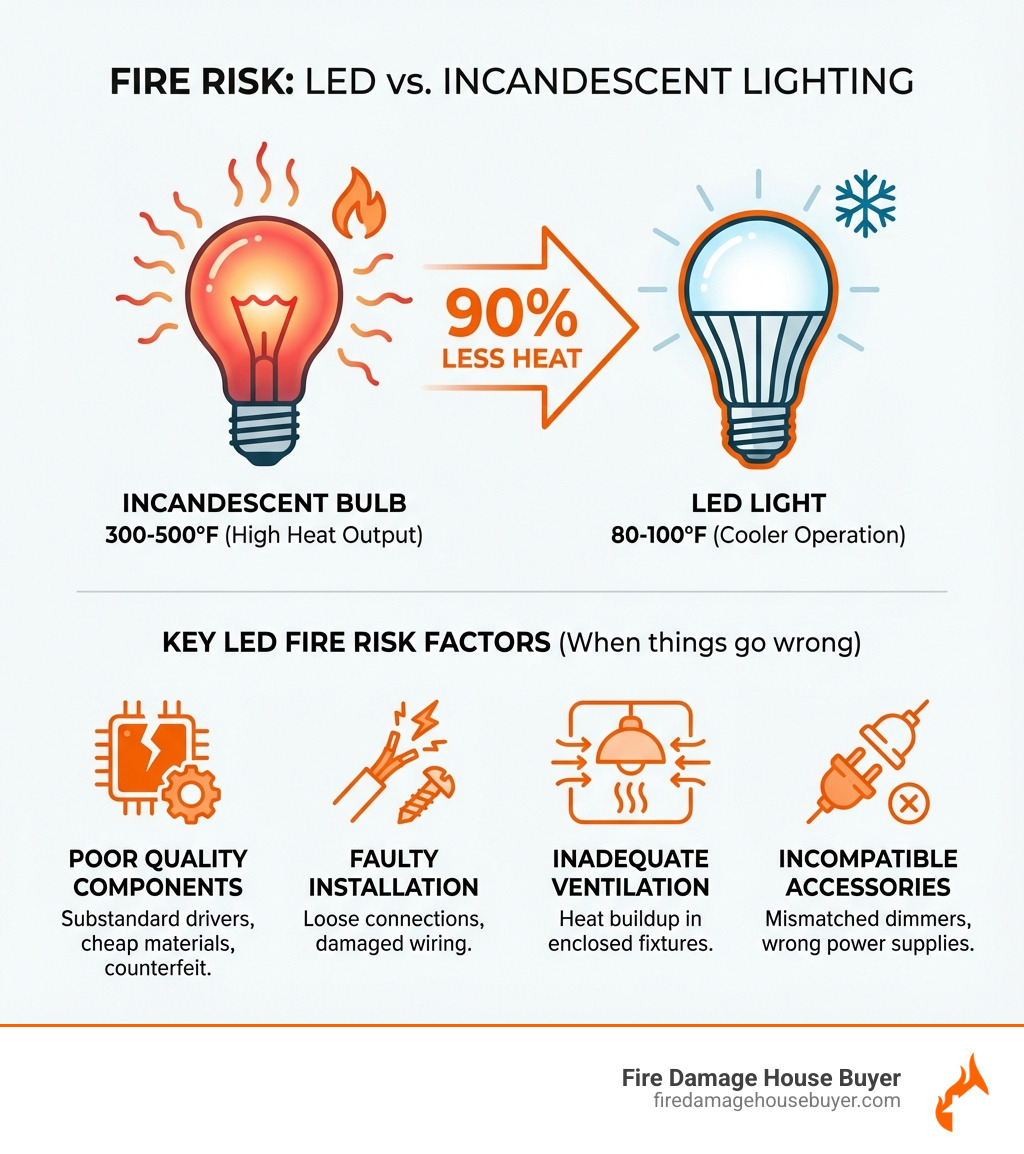
Can LED lights cause a fire? Yes, LED lights can cause fires, but it’s important to understand that the risk is significantly lower than with traditional incandescent or halogen bulbs. While LED technology produces far less heat and is generally safer, fires can still occur due to several factors:
- Substandard components – Cheap materials, faulty drivers, or counterfeit products lacking proper safety testing
- Incorrect installation – Loose connections, damaged wiring, or incompatible electrical systems
- Poor ventilation – Heat buildup in enclosed fixtures or from insulation contact
- Incompatible accessories – Using non-LED dimmers or mismatched power supplies
- Overloaded circuits – Exceeding electrical capacity, particularly with LED strips or high-intensity grow lights
The bottom line: Quality LED lights from reputable manufacturers, properly installed with adequate ventilation, pose minimal fire risk. However, poor-quality products, DIY installation mistakes, or improper use can create dangerous conditions.
LED lighting has revolutionized how we illuminate our homes and businesses. The promise is compelling: dramatically lower energy costs, bulbs that last for years instead of months, and a cooler, safer alternative to the old incandescent bulbs that could scorch your fingers if touched. With LED lights consuming around 75% less energy than traditional bulbs and operating at temperatures up to 90% cooler, it’s no wonder they’ve become the go-to choice for homeowners everywhere.
But as with any electrical product, questions about safety naturally arise. You’ve likely heard that LEDs are inherently safer because they don’t get as hot. That’s true—but it’s not the complete picture. While the technology itself is remarkably efficient, the quality of manufacturing, the method of installation, and the conditions of use all play critical roles in whether these lights remain safe or become a potential hazard.
As Daniel Cabrera, I’ve worked with over 275 homeowners dealing with fire-damaged properties, and I’ve seen how even seemingly safe products can contribute to devastating electrical fires when things go wrong. Understanding whether can LED lights cause a fire helps homeowners make informed decisions about their lighting choices and recognize potential hazards before they escalate.
You may also want to read the following articles:
Understanding LED Technology and Fire Risk
To truly grasp whether can LED lights cause a fire, we need to peek under the hood of this modern marvel. LED stands for Light Emitting Diode. Unlike traditional bulbs that rely on heating a filament or exciting gases, LEDs convert electrical energy directly into light using semiconductor technology. This process, called electroluminescence, is incredibly efficient.
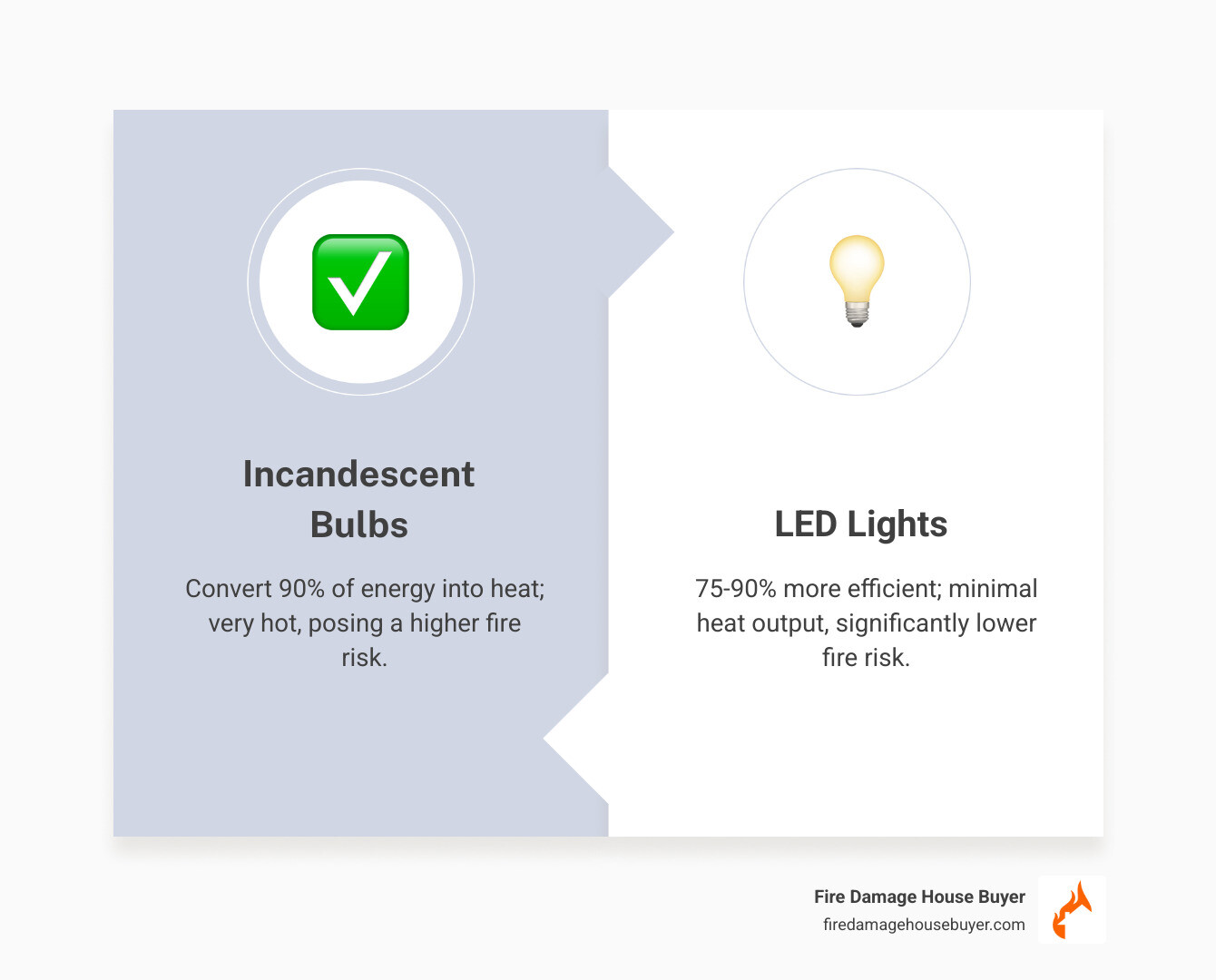
This fundamental difference is why LEDs are celebrated for their energy efficiency and lower heat output. An incandescent bulb, for example, converts only about 10% of the electricity it uses into visible light, with the remaining 90% wasted as heat. Imagine that! It’s like having a tiny, inefficient heater masquerading as a light bulb. Halogen bulbs are even hotter. LEDs, on the other hand, consume around 75% less energy than incandescents, meaning a much smaller fraction of that energy is converted into heat. This makes them significantly cooler to the touch and less likely to ignite nearby flammable materials.
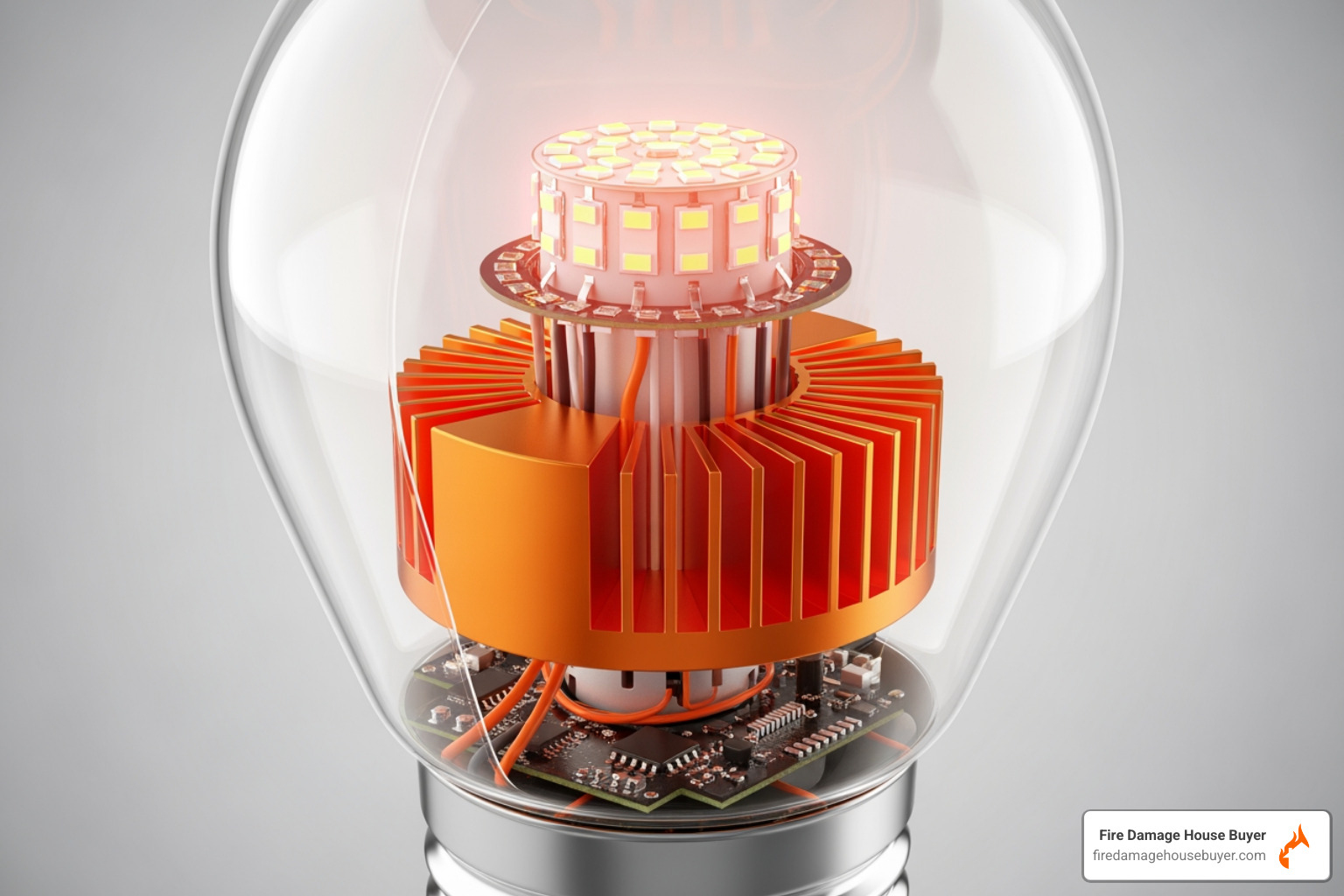
However, “less heat” doesn’t mean “no heat.” LEDs still generate some heat, primarily at the junction where the semiconductor operates. This is where thermal management, particularly the use of heat sinks, becomes crucial for both the longevity and safety of LED products.
How LED Heat Generation Differs from Traditional Bulbs
The efficiency of LED technology is truly remarkable. While incandescent bulbs literally glow hot, wasting most of their energy as heat (primarily infrared radiation), LEDs are designed to minimize this. Our research tells us that incandescent bulbs convert a whopping 90% of their energy into heat, making them a significant fire risk if not handled carefully or placed too close to combustible materials.
LEDs, by contrast, are up to 90% more efficient at converting electricity into light. This means they produce significantly less heat. While you might feel a slight warmth from an LED bulb, it’s rarely enough to cause a burn, let alone start a fire. This cooler operating temperature is one of their primary safety advantages over older lighting technologies.
The Crucial Role of the Heat Sink
Despite their efficiency, LEDs do produce some heat at the semiconductor junction. If this heat isn’t managed effectively, it can lead to what’s known as “thermal degradation.” This is where the LED chip or its driver can overheat, leading to reduced performance, a shorter lifespan, and, in extreme cases, a potential fire hazard.
This is where the humble heat sink steps in. A heat sink is a passive heat exchanger that draws heat away from the LED components and dissipates it into the surrounding air. Think of it as the cooling system for your LED light. High-quality LED products are designed with effective heat sinks to ensure that the internal components remain within safe operating temperatures. This not only prevents premature failure but also plays a vital role in preventing overheating that could lead to a fire. Proper thermal management, often indicated by an ENERGY STAR certification, is a hallmark of a safe and durable LED product.
| Lighting Type | Energy Use (vs. Incandescent) | Heat Output (Relative) | Lifespan (Relative) | Fire Risk (General) |
|---|---|---|---|---|
| Incandescent | 100% | High (90% as heat) | Short | Higher |
| CFL | 25-35% | Medium | Medium | Medium |
| LED | 10-25% | Low (minimal IR) | Long | Lower (when proper) |
So, Can LED Lights Cause a Fire? Unpacking the Primary Causes
While the inherent design of LED lights makes them less prone to fire than their predecessors, it’s not a zero-risk scenario. Our research, including studies from the National Fire Protection Association (NFPA), indicates that electrical distribution equipment, which includes lighting, contributes to a significant number of residential fires. For example, an estimated annual average of 18,700 fires was attributable to electrical distribution equipment, accounting for 5.2% of residential fires from 2016-2018. While this doesn’t isolate LEDs, it highlights that electrical systems, including lighting, are a factor in house fires.
When we ask ourselves, “can LED lights cause a fire?”, the answer often lies not in the LED itself, but in external factors or failures within the broader lighting system. These typically fall into a few key categories: substandard components, incorrect installation, poor ventilation, and incompatible accessories.
Substandard Components and Counterfeit Products
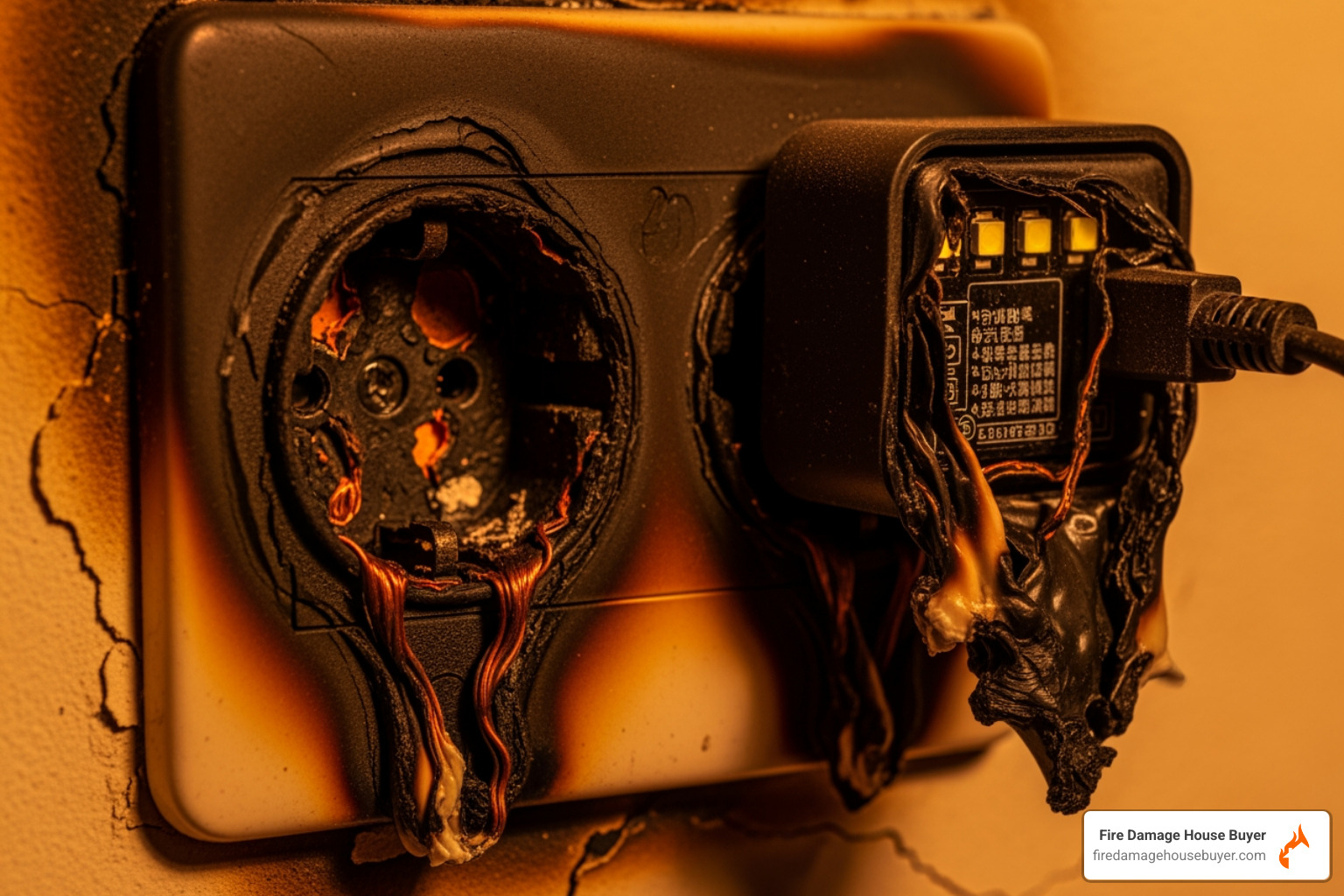
This is perhaps one of the most critical risk factors. The market is flooded with LED products, and unfortunately, not all are created equal. Low-quality manufacturing, often seen in cheap, unbranded, or counterfeit LED lights, can lead to serious hazards. These products might use inferior materials for wiring, faulty drivers (the component that regulates power to the LED), or inadequate insulation.
Common faults in such products include:
- Short circuits: Poorly shielded wires or components can touch, creating a direct path for electricity and generating intense heat.
- Insulation failures: Deteriorated or low-quality insulation can expose live wires, leading to arcing or short circuits.
- Component breakdowns: Cheap drivers or power supplies can fail catastrophically, sometimes sparking or overheating to dangerous levels.
These issues often stem from a lack of rigorous testing and quality control. When you purchase an LED product, especially online or from an unfamiliar vendor, you might be getting something that hasn’t met any safety standards. The danger of counterfeit lights is real; they might look like the real deal but lack the internal safeguards. If your house experiences a fire due to such components, understanding what happens if your house burns down becomes a grim reality.
Incorrect Installation and Faulty Wiring
Even the highest quality LED light can become a fire hazard if installed incorrectly. DIY installation mistakes are a common culprit. We often see issues arise from:
- Loose connections: Wires not properly secured can arc, overheat, and ignite nearby materials.
- Overloaded circuits: Plugging too many lights or power-hungry LED grow lights into a single circuit can exceed its capacity, leading to tripped breakers, overheating wires, and potential fires.
- Incompatible wiring: Using old, damaged, or undersized wiring for new LED installations can lead to resistance and heat buildup.
- Damaged power cords: Frayed or pinched power cords, especially with LED strip lights or grow lights, can expose live wires and create a fire risk.
Our experience shows that electrical issues are a leading cause of residential fires. In fact, what is the number one cause of house fires often points back to electrical problems, and improper lighting installation is a contributing factor. For peace of mind and safety, it’s always best to consult or hire a qualified electrician for any complex LED installation.
Overheating from Poor Ventilation
While LEDs produce less heat than traditional bulbs, they still require adequate heat dissipation. If heat gets trapped, it can cause the LED components to overheat, leading to degradation and potential fire. This is particularly a concern in:
- Enclosed fixtures: Using an LED bulb not rated for enclosed fixtures can lead to heat buildup.
- Recessed lighting: If recessed LED fixtures are installed without proper clearance from insulation or other materials, heat can accumulate.
- Insulation contact: If insulation touches the body of an LED fixture, it can prevent heat from escaping.
- Dust and debris buildup: A thick layer of dust on an LED light can act as an insulator, trapping heat and increasing the risk of overheating.
- Reduced airflow: Placing LED strip lights in tight, unventilated spaces (e.g., behind furniture, inside cabinets) can restrict airflow and cause them to overheat.
Excessive heat can degrade the internal components, including the plastic housing or the driver, potentially leading to a fire. Even if the LED chip itself doesn’t ignite, other components can.
Incompatible Accessories and System Mismatches
The world of LED lighting can be a bit finicky when it comes to compatibility. One common mistake is using dimmers designed for incandescent bulbs with LEDs. These older dimmers can cause:
- Voltage fluctuations: Leading to flickering or buzzing, which stresses the LED driver.
- Overheating the driver: Incompatible dimmers can cause the LED driver to work harder, generating excessive heat.
Similarly, using mismatched power supplies (e.g., incorrect voltage or wattage) or exceeding the recommended wattage limits for an LED fixture can lead to component stress and overheating. These system mismatches directly contribute to the question of can LED lights cause a fire by creating conditions ripe for electrical failure. Always ensure all components—lights, drivers, dimmers, and power supplies—are compatible and rated for your specific LED setup.
Fire Risk by LED Type: Bulbs, Strips, and Grow Lights
Not all LED lights are created equal when it comes to fire risk. Their design, power consumption, and typical installation methods mean varying levels of potential hazard. Let’s look at the different types.
Standard LED Bulbs
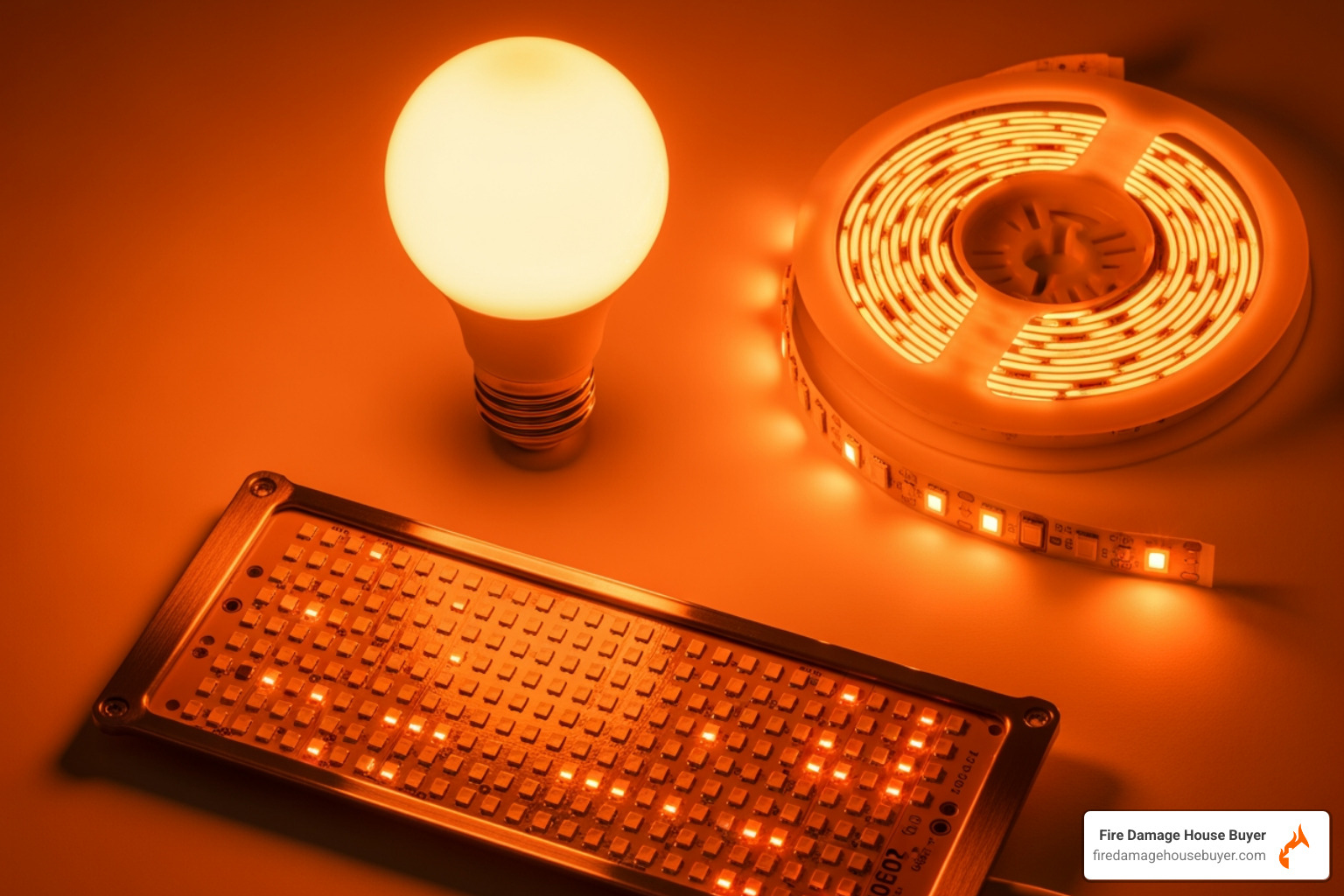
These are the most common type, designed to replace traditional incandescent or CFL bulbs in existing fixtures. Generally, standard LED bulbs represent the lowest fire risk among LED products. They are self-contained units with integrated heat sinks and drivers.
The primary risks with standard LED bulbs usually come from:
- Using them in fully enclosed fixtures: If a standard LED bulb is not rated for enclosed fixtures, the trapped heat can cause it to overheat and fail prematurely, though rarely to the point of fire.
- Poor quality manufacturing: As discussed, cheap, uncertified bulbs can have faulty components.
- Old, faulty wiring in the fixture: The problem isn’t the bulb, but the electrical system it’s plugged into.
When purchased from reputable brands and used according to manufacturer instructions, standard LED bulbs are incredibly safe.
LED Strip Lights
LED strip lights have become immensely popular for decorative and accent lighting due to their flexibility and ease of installation. However, they can pose a higher fire risk compared to standard bulbs, largely due to their installation and the components often used with them.
Risk factors for LED strip lights include:
- DIY customization: Cutting and soldering errors can create short circuits or loose connections.
- Overloading power supplies: Using a power supply that isn’t robust enough for the length or wattage of the strip can cause the power supply itself to overheat and fail.
- Cheap, uncertified kits: Many inexpensive LED strip kits come with low-quality power adapters and controllers that are prone to overheating.
- Adhesive failure: If strips detach and fall onto flammable surfaces, or if connections are strained.
- Proximity to flammable materials: Often used for accent lighting, they might be installed near curtains, paper, or other easily ignitable items.
While LED strip lights are generally safe, incidents can occur when quality is compromised or installation is improper. Reports have highlighted instances where faulty LED strip lights have malfunctioned, sometimes leading to fires. For more context on such dangers, you can refer to discussions around incidents like the Ingle Farm incident report.
High-Intensity LED Grow Lights
LED grow lights, designed for indoor horticulture, represent the highest fire risk among common LED applications. This is due to several factors:
- High power consumption: These lights are designed to be powerful, emitting intense light over long periods. This means they generate more heat than typical household LEDs.
- Significant heat output: While still more efficient than traditional HPS (High-Pressure Sodium) grow lights, high-intensity LEDs still produce considerable heat, requiring robust active cooling systems (fans) and large heat sinks.
- Continuous operation: Grow lights often run for 12-18 hours a day, placing continuous stress on components.
- Environment: Grow tents or rooms can be humid and enclosed, further complicating heat dissipation and increasing electrical risks.
For grow lights, quality and proper setup are paramount. Investing in reputable brands with strong safety certifications, ensuring adequate ventilation, and regularly inspecting components are crucial to mitigate the risks.
A Homeowner’s Safety Checklist to Prevent LED Fires
Preventing an electrical fire from any source, including LED lights, comes down to vigilance, quality choices, and proper installation. Here’s our homeowner’s safety checklist to minimize the risk that can LED lights cause a fire in your home.
Choose Certified Products and Reputable Brands
This is your first and most important line of defense. Always, always, always purchase LED lights and their associated components (drivers, power supplies, dimmers) from reputable manufacturers and retailers. Look for safety certifications from recognized organizations.
What these labels mean for fire safety:
- UL Listed (Underwriters Laboratories): The UL mark is one of the most respected safety certifications in North America. It means that UL has tested representative samples of the product and determined that it meets their safety requirements. UL specifically tests LED lights for fire hazards and safety in enclosed fixtures.
- ETL Listed (Electrical Testing Laboratories): Similar to UL, the ETL mark indicates that the product has been tested by Intertek and found to be compliant with North American safety standards.
- CE Marking (Conformité Européenne): While primarily for products sold in the European Economic Area, it indicates that a product complies with EU health, safety, and environmental protection standards. Some international products may carry this.
Avoiding uncertified products, especially those that seem “too good to be true” in price, is critical. These often bypass safety testing and use substandard components, significantly increasing your fire risk. The U.S. Consumer Product Safety Commission (CPSC) provides excellent guidance on Electrical Products and emphasizes the importance of product safety.
Best Practices for Safe Installation and Use
Once you have quality products, how you install and use them makes all the difference.
- Follow manufacturer instructions: Seriously, read the manual! It contains vital information on installation, compatible accessories, and environmental considerations.
- Ensure adequate ventilation: Never enclose an LED light in a fixture or space not rated for it. Provide ample airflow around LED fixtures, especially strip lights and grow lights. Avoid obstructing heat sinks.
- Do not overload circuits: Be mindful of the total wattage on a circuit. If you’re using many LED strips or powerful grow lights, ensure your electrical system can handle the load. Use power strips with built-in overload protection.
- Use compatible dimmers: If you want to dim your LEDs, invest in dimmers specifically designed for LED technology. Mismatched dimmers can cause flickering, buzzing, and overheating.
- Regular inspections for damage: Periodically check power cords, fixtures, and connections for any signs of wear, fraying, discoloration, or loose parts. Replace damaged components immediately.
- Keep lights clear of flammable materials: While LEDs are cooler, it’s still best practice to keep them away from curtains, paper, fabrics, and other combustible items.
- Keep them clean: Regularly cleaning LED fixtures can prevent dust buildup, which can insulate and trap heat.
Following these practices is essential for preventing incidents and can also help you avoid having to deal with the aftermath of a fire, such as figuring out how to get rid of fire smoke smell in house.
Recognizing the Warning Signs of a Potential Electrical Fire
Your electrical system often gives you clues before a serious problem occurs. Pay attention to these warning signs from your LED lights and associated electrical components:
- Flickering or dimming lights: Inconsistent light output can indicate a faulty bulb, driver, or an issue with the electrical connection.
- Buzzing or humming sounds: While some LED drivers can make a faint noise, a noticeable or new buzzing sound is a red flag for electrical issues.
- Burning odors: A smell of burning plastic or electrical insulation is a serious warning sign.
- Discoloration on fixtures or outlets: Burn marks or discoloration around the light fixture, switch, or outlet indicate overheating.
- Outlets warm to the touch: An outlet or switch plate that is unusually warm (beyond slightly warm from normal operation) could signal an overloaded circuit or faulty wiring.
- Tripping circuit breakers: If a circuit breaker frequently trips when you use your LED lights, it’s a sign of an overload or short circuit.
If you notice any of these signs, don’t ignore them. Immediately unplug or turn off the affected lights and consult a qualified electrician. Ignoring these warnings could lead to a fire. After any fire incident, even a small one, you’ll need to determine if it’s safe to stay after fire and assess the damage.
The Aftermath: Dealing with an Electrical Fire
Even a seemingly small electrical fire, perhaps starting from a faulty LED driver or an overloaded strip light, can have devastating consequences. We’ve seen how quickly a minor incident can escalate, causing widespread damage to a home and its contents. The complexity of recovery after a fire is often underestimated. Beyond the visible charring, there are hidden dangers, such as structural compromises and the pervasive issue of smoke contamination after fire. This acidic residue can corrode electronics, stain walls, and leave a lingering, acrid odor that is incredibly difficult to remove.
The emotional and financial toll on homeowners is immense. Your home is not just a building; it’s a repository of memories, security, and comfort. Seeing it damaged by fire is heartbreaking.
The Overwhelming Challenges of Recovery
Once the flames are out and the immediate danger has passed, the daunting path to recovery begins. This journey is often fraught with challenges that go far beyond the physical damage:
- Navigating insurance claims: Dealing with adjusters, documentation, and protracted negotiations can be a full-time job.
- Unexpected costs: Even with insurance, deductibles, uncovered items, and unforeseen issues can quickly drain your finances. The costs to make a home livable again can vary widely. Minor smoke damage might cost between $3,000 to $10,000, while moderate structural damage could range from $20,000 to $75,000. For severe fires requiring extensive rebuilding, costs can easily climb into the hundreds of thousands of dollars.
- Long timelines for repair: The process from assessment to having a livable home again can take months, sometimes even over a year, leaving you displaced and stressed.
- The stress of managing the process: Overseeing everything, making countless decisions, and living in limbo can be incredibly taxing on your mental and emotional well-being.
The overwhelming nature of this situation often leads homeowners to seek alternatives. We understand that after a fire, you just want to move forward.
Conclusion: Prioritizing Safety and Making Smart Choices After a Fire
The question, “can LED lights cause a fire?” has a nuanced answer. While LED technology is inherently safer and more efficient than traditional lighting, it is not entirely foolproof. The vast majority of LED-related fires stem from external factors: substandard components, incorrect installation, poor ventilation, or incompatible accessories. Prioritizing quality products from reputable manufacturers and adhering strictly to proper installation and usage guidelines are paramount for ensuring safety.
However, even with the best precautions, accidents can happen. A small electrical fire, regardless of its origin, can lead to catastrophic damage, disrupting lives and causing immense financial strain. As we’ve explored, the path to recovery after a fire is often far more complex, costly, and emotionally draining than homeowners anticipate. The unexpected costs, the lengthy timelines, and the sheer stress of dealing with a damaged property can be overwhelming.
For many homeowners in Alabama, Alaska, Arizona, Arkansas, California, Colorado, Connecticut, DC, Delaware, Florida, Georgia, Hawaii, Idaho, Illinois, Indiana, Iowa, Kansas, Kentucky, Louisiana, Maine, Maryland, Massachusetts, Michigan, Minnesota, Mississippi, Missouri, Montana, Nebraska, Nevada, New Hampshire, New Jersey, New Mexico, New York, North Carolina, North Dakota, Ohio, Oklahoma, Oregon, Pennsylvania, Rhode Island, South Carolina, South Dakota, Tennessee, Texas, Utah, Vermont, Virginia, Washington, West Virginia, Wisconsin, and Wyoming facing fire damage, a faster, simpler solution is often needed. We understand that you might not want to steer the complexities of rebuilding, insurance battles, or the uncertainty of a damaged property.
That’s where we come in. Our company offers a straightforward alternative by purchasing your fire-damaged property ‘as is’ for cash. This approach completely bypasses the stress of dealing with repairs, the headaches of insurance claims, and the lengthy delays of traditional home sales. If you’re facing the aftermath of a fire and seeking the easiest path forward, consider getting a cash offer for your house today. We’re here to help you move on quickly and hassle-free.