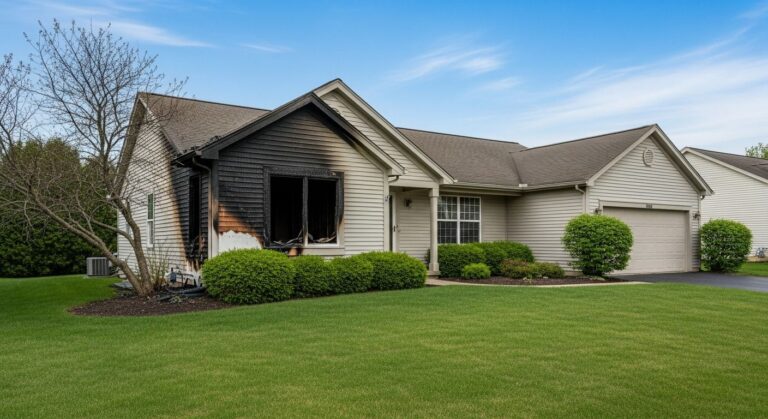
Dealing with fire damage is overwhelming, and one of the first questions homeowners ask is: does homeowners insurance cover fire damage? The short answer is yes — most standard homeowners insurance policies cover fire damage. But the details matter.
Your policy limits, deductible, the cause of the fire, and how well you document the damage all affect what you actually receive. Some situations, like arson or neglect, can void your coverage entirely. And even when insurance does pay out, many homeowners discover the settlement falls short of their actual losses.
This guide breaks down exactly what homeowners insurance covers after a fire, what it doesn’t, how to file a claim, and what options you have when insurance isn’t enough.
What Does Homeowners Insurance Cover After a Fire?
Most homeowners insurance policies include four types of coverage that apply after a fire. Understanding each one helps you know what to expect from your insurer and spot gaps in your settlement.
Dwelling Coverage (Coverage A)
Dwelling coverage pays to repair or rebuild the physical structure of your home. This includes walls, flooring, roofing, plumbing, electrical systems, built-in appliances, and attached structures like a garage or deck.
The payout depends on whether your policy uses replacement cost or actual cash value:
- Replacement cost covers what it costs to rebuild today, without deducting for depreciation.
- Actual cash value deducts depreciation based on the age and condition of your home, resulting in a lower payout.
Replacement cost policies provide significantly better protection after a fire, though they come with higher premiums.
Personal Property Coverage (Coverage C)
Personal property coverage helps replace your belongings — furniture, clothing, electronics, appliances, and other household items destroyed or damaged by fire, smoke, or water used to extinguish the flames.
Most policies cap personal property coverage at 50% to 70% of your dwelling coverage limit. So if your home is insured for $300,000, your belongings are typically covered up to $150,000 to $210,000.
Keep in mind that high-value items like jewelry, art, and collectibles often have sub-limits. You may need a separate rider or endorsement for full coverage on these items.
Other Structures Coverage (Coverage B)
If fire damages structures on your property that aren’t attached to your home — such as a detached garage, shed, fence, or pool house — other structures coverage helps pay for repairs or replacement.
This coverage is typically set at about 10% of your dwelling coverage limit, though you can adjust it with your insurer.
Additional Living Expenses (Coverage D)
If your home is uninhabitable after a fire, additional living expenses (ALE) coverage pays for temporary housing, meals, and other necessary costs while your home is being repaired or rebuilt.
ALE coverage usually lasts for a set period (often 12 to 24 months) or until your home is livable again, whichever comes first. This can include hotel stays, rental housing, restaurant meals, and even laundry costs.
What Types of Fires Does Homeowners Insurance Cover?
Fire is classified as a “basic named peril” in homeowners insurance, meaning it’s covered under even the most basic policies. However, the cause of the fire matters when it comes to your claim.
Fires Typically Covered
Most homeowners policies cover accidental fires caused by:
- Cooking accidents — the leading cause of home fires in the United States
- Electrical malfunctions — faulty wiring, overloaded circuits, or defective appliances
- Heating equipment failures — furnaces, space heaters, and fireplaces
- Lightning strikes — both the fire and resulting damage
- Wildfires — typically covered, though policies in high-risk areas may have limitations
- Chimney fires — caused by creosote buildup or lack of maintenance
- Candle fires — accidental fires from unattended candles
Fires That May NOT Be Covered
Not every fire-related loss falls under your policy. Common exclusions include:
- Arson by the homeowner — intentionally setting fire to your own property is insurance fraud and a criminal offense
- Vacant or unoccupied homes — many policies exclude coverage if the home has been vacant for 30 to 60 days or more
- Neglect — if a fire results from known hazards you failed to address (like faulty wiring you were warned about), your insurer may deny the claim
- Acts of war — fire caused by war, terrorism, or nuclear events is typically excluded
- Code upgrade costs — if rebuilding requires updates to meet current building codes, standard policies may not cover the extra expense unless you have an ordinance or law endorsement
Does Homeowners Insurance Cover Wildfires?
Yes, most standard homeowners policies cover wildfire damage. However, if you live in a high-risk wildfire zone (common in California, Colorado, Oregon, and other western states), your insurer may impose special deductibles, limit coverage, or decline to renew your policy.
Homeowners in high-risk areas who cannot get private coverage can often access state-run FAIR (Fair Access to Insurance Requirements) Plans, which provide basic fire coverage as a last resort.
Does Homeowners Insurance Cover Smoke Damage?
Yes. Smoke damage — including soot, odor, and particulate contamination — is generally covered as part of your fire damage claim. Smoke can travel through HVAC systems and affect areas of your home far from the actual flames, so the scope of smoke damage is often larger than homeowners expect.
Related: What Is Smoke Damage? A Homeowner’s Guide
How to File a Fire Damage Insurance Claim
Filing a fire damage claim quickly and correctly improves your chances of getting a fair settlement. Here’s a step-by-step overview of the process.
Step 1: Ensure Safety First
Before anything else, make sure everyone is safe and accounted for. Do not re-enter a fire-damaged home until the fire department clears it as structurally safe.
Step 2: Contact Your Insurance Company
Notify your insurer as soon as possible — most policies require prompt reporting. Your insurance company will assign an adjuster to assess the damage.
Step 3: Document Everything
Thorough documentation is critical for your claim:
- Take photos and videos of all damage before any cleanup begins
- Create a detailed inventory of damaged or destroyed belongings, including estimated values
- Keep receipts for temporary living expenses
- Save any communications with your insurance company
Step 4: Get Repair Estimates
Obtain independent repair estimates from licensed contractors. Don’t rely solely on your insurer’s estimate, as their numbers may be lower than actual repair costs.
Step 5: Review the Settlement Offer
Your insurer will present a settlement offer based on their adjuster’s assessment. Review it carefully. If it seems low, you have the right to negotiate or hire a public adjuster to advocate on your behalf.
For a detailed walkthrough of the claims process, read our guide on how to file a fire damage insurance claim.
Understanding Your Coverage Limits and Deductible
Two numbers in your policy directly affect how much you receive after a fire: your coverage limit and your deductible.
Coverage Limits
Your coverage limit is the maximum your insurer will pay for a covered loss. If rebuilding your home costs $350,000 but your dwelling coverage limit is $300,000, you’re responsible for the $50,000 gap.
Review your policy annually. Rising construction costs and inflation can push rebuilding costs well beyond your current coverage limit. Many insurers offer an inflation guard endorsement that automatically adjusts your coverage limit each year.
Deductible
Your deductible is the amount you pay out of pocket before insurance kicks in. For example, with a $2,500 deductible on a $100,000 claim, your insurer pays $97,500 and you cover the rest.
Higher deductibles lower your monthly premium but increase your out-of-pocket cost when you file a claim. Choose a deductible you can comfortably afford in an emergency.
When Insurance Falls Short: Your Options After a Fire
Even with insurance coverage, many homeowners find themselves in a difficult position after a fire. Common scenarios where insurance isn’t enough include:
- Underinsurance — your coverage limit doesn’t match the actual cost to rebuild
- Depreciation deductions — actual cash value policies reduce your payout based on the age of your home and belongings
- Claim denials — your insurer denies part or all of your claim due to policy exclusions
- Insufficient ALE — temporary living expenses exceed your coverage
- Code upgrade gaps — rebuilding to current codes costs more than your policy covers
When you’re facing a gap between what insurance covers and what you actually need, you have a few paths forward:
Option 1: Rebuild Out of Pocket
You can supplement your insurance payout with personal savings, home equity loans, or other financing. This works if the gap is small, but for major damage, the financial burden can be significant.
Option 2: Negotiate with Your Insurer
If your claim was undervalued, push back. Get independent estimates, document everything, and consider hiring a public adjuster to negotiate a better settlement.
Option 3: Sell Your Fire-Damaged Home As-Is
If rebuilding isn’t financially viable — or you simply want to move forward without the stress — selling your fire-damaged home for cash is a real option. You can sell the property in its current condition, without making any repairs.
At Fire Damage House Buyer, we purchase fire-damaged homes nationwide. We provide fair cash offers, handle the process quickly, and can close in as little as 7 days. There are no agent commissions, no repair requirements, and no hidden fees.
Get your cash offer today or call us at (844) 714-3778 for a free, no-obligation consultation.
How to Protect Yourself Before a Fire Happens
The best time to review your fire coverage is before you need it. Here’s how to make sure you’re adequately protected:
- Review your declarations page — confirm your dwelling coverage matches the current cost to rebuild your home, not its market value
- Choose replacement cost over actual cash value — it costs more in premiums but pays significantly more when you file a claim
- Add an ordinance or law endorsement — this covers the cost of rebuilding to current building codes
- Create a home inventory — document your belongings with photos, videos, and estimated values and store the inventory off-site or in the cloud
- Increase personal property limits if needed — schedule high-value items like jewelry, art, and collectibles separately
- Install and maintain smoke detectors — working smoke detectors reduce fire fatalities and may lower your premiums
- Review your policy annually — construction costs rise, and your coverage should keep pace
Frequently Asked Questions
Does homeowners insurance cover fire damage to a neighbor’s property?
It depends. If a fire starts at your home and spreads to a neighbor’s property, your liability coverage (Coverage E) may help cover the damage. However, your neighbor would typically file a claim under their own homeowners policy first. If they pursue you for damages beyond what their policy covers, your liability coverage could apply.
Is fire damage covered by homeowners insurance if the house is vacant?
Often, no. Many homeowners insurance policies exclude coverage for fire damage if the home has been vacant or unoccupied for more than 30 to 60 consecutive days. If you have a vacant property, consider a separate vacant property insurance policy to maintain coverage.
How long does a fire insurance claim take to settle?
Fire damage claims typically take anywhere from a few weeks to several months to settle, depending on the severity of the damage, the completeness of your documentation, and your insurer’s workload. Total loss claims can take six months or longer.
For more details, read our guide on how long a fire insurance claim takes.
Does homeowners insurance cover fire damage from faulty wiring?
Yes, if the fire was caused by a sudden electrical malfunction, your homeowners insurance will typically cover it. However, if the insurer determines that you knew about faulty wiring and failed to address it, they may argue negligence and deny the claim.
What should I do if my fire damage claim is denied?
If your claim is denied, request a written explanation from your insurer. Review the denial against your policy terms. You can appeal the decision, hire a public adjuster, or consult an attorney who specializes in insurance disputes. Read our guide on what to do when your fire damage insurance claim is denied.
Can I sell my house after a fire without making repairs?
Yes. You are not required to repair a fire-damaged home before selling it. Cash buyers like Fire Damage House Buyer specialize in purchasing homes in as-is condition. This can be a faster, less stressful option than rebuilding, especially when insurance doesn’t cover the full cost of repairs.