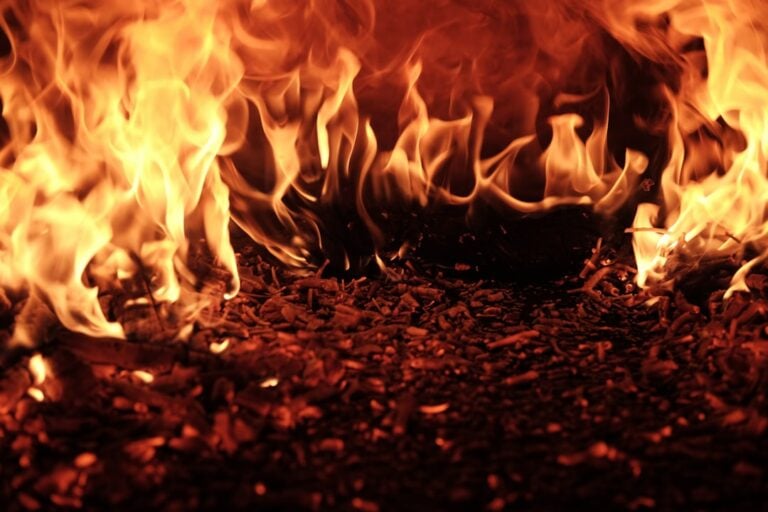
Understanding the Intense Heat of Flames
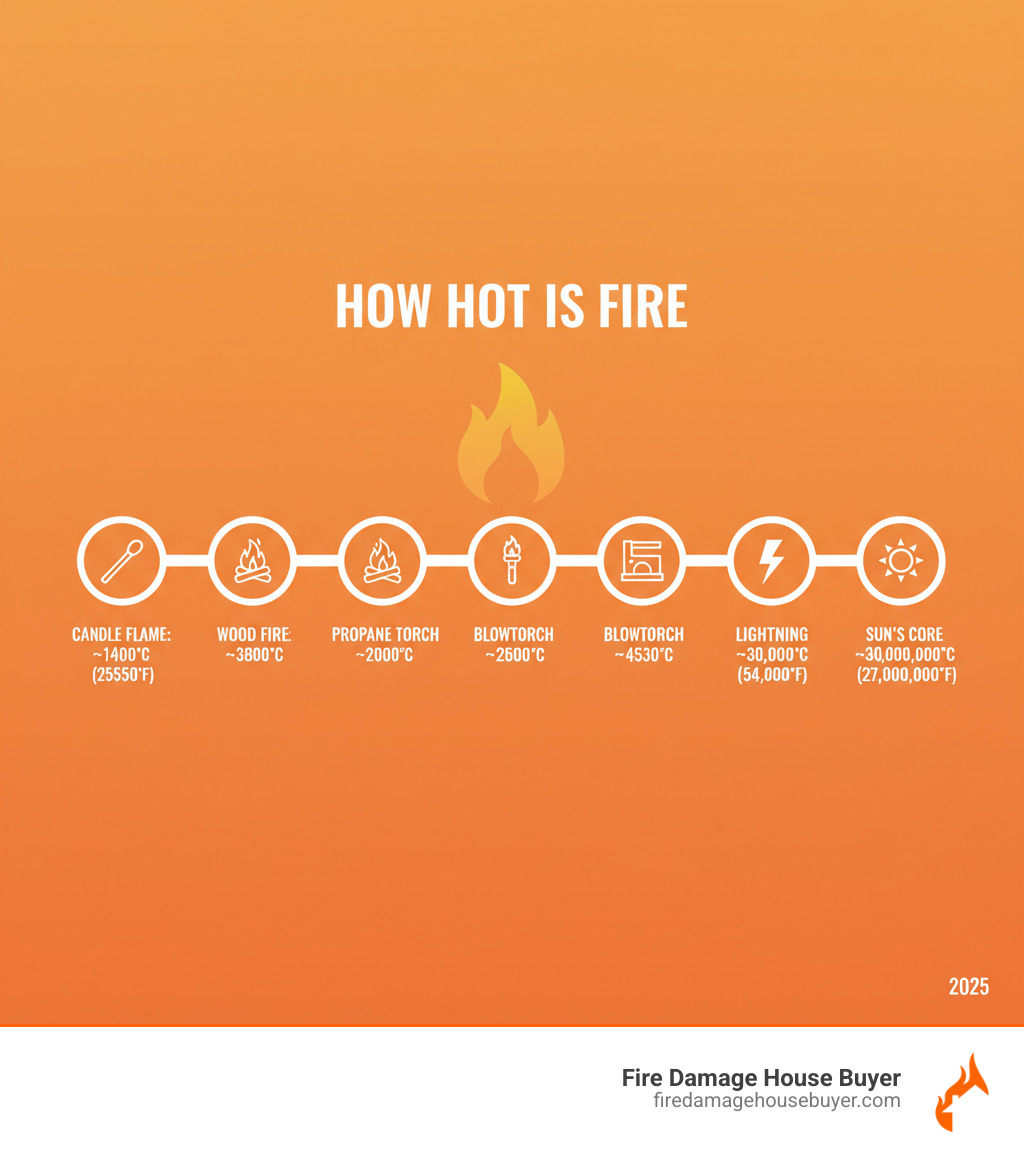
How hot is fire? Fire temperatures vary dramatically, from around 600°C (1,112°F) for a red flame to over 3,000°C (5,432°F) for an intense blue flame. The fuel source and conditions are key. Here’s a quick reference:
| Flame Color | Temperature Range | Common Source |
|---|---|---|
| Red | 600°C – 800°C (1,112°F – 1,800°F) | Wood fires, candles |
| Orange-Yellow | 1,100°C – 1,200°C (2,012°F – 2,192°F) | Campfires, cooking flames |
| White | 1,300°C – 1,500°C (2,372°F – 2,732°F) | Welding torches, intense fires |
| Blue | 1,400°C – 3,000°C (2,600°F – 5,432°F) | Gas burners, hottest flames |
Fire is one of nature’s most powerful forces. While it provides warmth, it can also destroy a home in minutes. The temperature of a fire is a critical factor that determines how quickly it spreads and the severity of the damage.
A typical house fire reaches 600°C to 1,100°C (1,112°F to 2,012°F), hot enough to melt aluminum, shatter glass, and compromise steel beams. During a phenomenon called flashover, temperatures spike even higher, engulfing an entire room in flames within seconds.
Understanding fire’s temperature isn’t just curiosity—it’s about grasping the scope of destruction to make informed decisions. I’m Daniel Cabrera, founder of Fire Damage House Buyer. With 15 years of experience assessing fire-damaged properties, I’ve seen the devastating effects of extreme heat firsthand. This has given me unique insight into the science of fire and the realities homeowners face.
This guide covers everything from the science of combustion to the heat of different flame colors. You’ll learn why some flames are hotter than others and what a house fire’s intense heat means for your property and recovery options.
The Science of Fire: What It Is and Why It’s Hot
Here’s a surprise: fire isn’t actually a “thing”. It’s not a substance you can bottle up. Fire is the visible evidence of a rapid, energetic chemical reaction called combustion.
When you watch flames, you’re witnessing energy being released as molecules break apart and recombine. It’s chemistry in action.
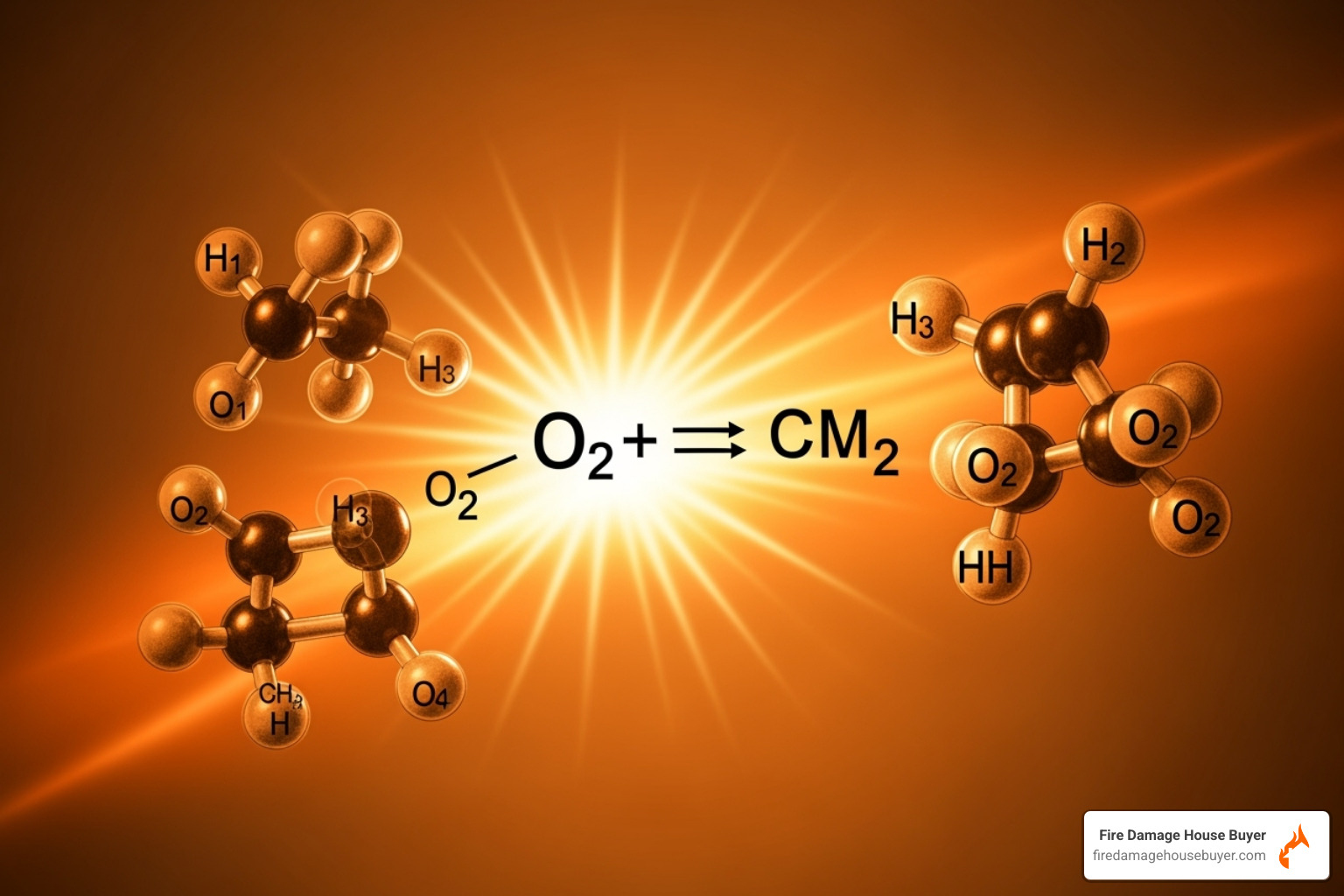
For fire to exist, you need four key elements: fuel, oxygen, heat, and an uninhibited chemical chain reaction. Scientists call this the fire tetrahedron. Remove any one of these elements, and the fire goes out. This is how fire extinguishers work—they break the chain.
But how hot is fire, and where does the heat come from?
The answer is that combustion is an exothermic reaction—it releases more energy than it consumes. When you strike a match, friction provides the initial heat to start a reaction between the match head’s chemicals and oxygen. Once started, the reaction generates its own heat, creating a self-sustaining flame.
The heat you feel comes from the breaking and forming of chemical bonds. Breaking bonds requires energy, but forming new ones (like carbon dioxide and water vapor) releases significantly more energy. That leftover energy is what we experience as heat and light.
Oxygen plays a starring role. As an oxidizing agent, it eagerly combines with fuel, driving the reaction and releasing thermal energy. The more efficiently oxygen combines with fuel, the hotter the fire burns. This is why blowing on embers makes them glow brighter—you’re feeding the fire more oxygen.
The principles of combustion explain why different fires have different temperatures. A candle flame is cooler than a gas stove because wax burns less efficiently than natural gas. A house fire can reach extreme temperatures because it has abundant fuel and the enclosed space concentrates the heat, creating a feedback loop that intensifies the reaction.
How Hot is Fire? A Guide to Flame Color and Temperature
Have you ever noticed the different colors in a campfire? That’s not just beautiful—it’s a natural thermometer at work. Surprisingly, when it comes to fire, blue flames are the hottest, not red. This is the opposite of our usual association where blue means cold and red means hot. With flames, the color spectrum works differently.
The science involves black-body radiation. As objects get hotter, the light they emit changes from red to orange, yellow, white, and finally blue at the highest temperatures. However, flame color is also about how completely the fuel is burning. Incomplete combustion, where there isn’t enough oxygen, creates tiny soot particles. These glowing particles produce the warm yellow and orange colors of a campfire. This is called soot incandescence.
When combustion is complete—with plenty of oxygen—the flame burns efficiently with less soot, producing a clean blue color from ionized gas emissions. This is why a well-adjusted gas stove has blue flames.
Flame Color and Temperature
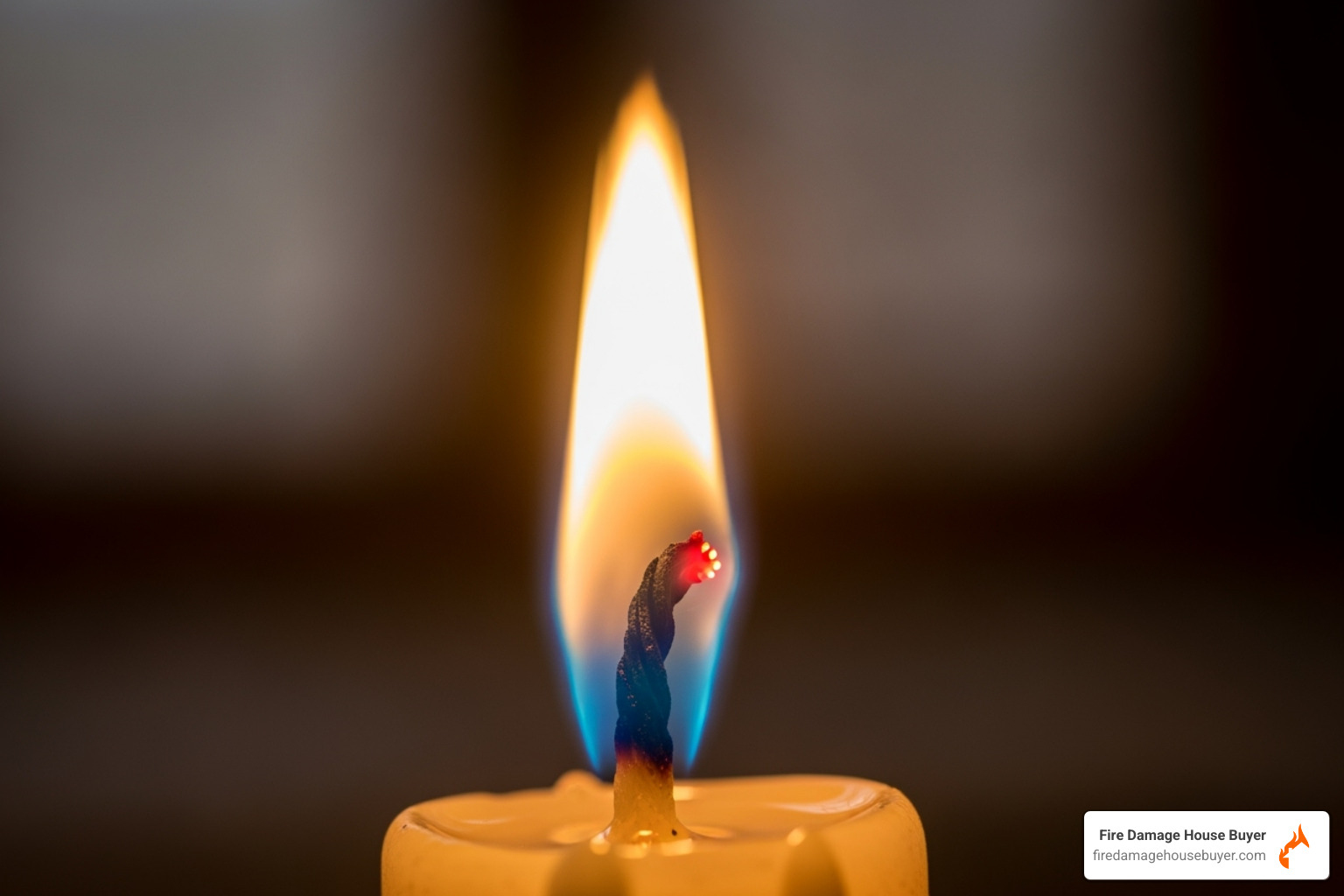
When people ask how hot is fire, the answer depends on the color. Here’s what we’ve learned from years of assessing fire damage:
Red flames are the coolest you’ll see, appearing at the edges of a fire or when something is smoldering. They indicate incomplete combustion and burn at approximately 600°C to 800°C (1,112°F to 1,800°F). Even at this “low” temperature, they can cause serious burns and ignite materials.
Orange-yellow flames, seen in most wood fires and candles, are hotter, reaching 1,100°C to 1,200°C (2,012°F to 2,192°F). This is the typical temperature range for the initial stages of a house fire. The warm, flickering light comes from dense clouds of soot burning at high temperatures.
White flames signal very high temperatures of 1,300°C to 1,500°C (2,372°F to 2,732°F). At this intensity, the soot particles are so hot they emit light across the entire visible spectrum. This can melt many common metals and cause catastrophic structural damage.
Blue flames are the hottest and most efficient, indicating complete combustion. They can reach anywhere from 1,400°C to 3,000°C (2,600°F to 5,432°F). A gas burner’s blue flame is at the lower end of this range, while specialized industrial flames can reach the upper limits.
Understanding these temperature differences is crucial. When dealing with fire damage, knowing your house fire likely reached 1,000°C or more helps explain why aluminum frames melted, glass shattered, and steel beams may have lost their structural integrity. It’s also why restoration is often far more complex than homeowners realize.
The Destructive Reality: Fire Temperatures in a House Fire
While understanding flame colors is interesting, the reality of how hot is fire in a home is sobering. A small flame can become a major fire in under 30 seconds, and an entire home can be engulfed within five minutes, leaving little time to escape.
The heat in an enclosed space drives destruction. At floor level, temperatures might be 100°F (37.8°C), but at eye level, they can soar to 600°F (315.5°C). This is why firefighters crawl low to find breathable air and avoid the most intense heat.
One of the most dangerous phenomena is flashover. This occurs when a room reaches ignition temperature, around 500-600°C (932-1,112°F), causing all combustible materials to ignite at once. During flashover, temperatures can surge beyond 1,000°C (1,832°F), making survival impossible. Our guide on how hot does a house fire get details these deadly heat levels.
The aftermath is overwhelming, from melted appliances and warped steel beams to compromised structural integrity. The physical destruction, emotional toll, and insurance complexities are crushing for homeowners.
How hot is fire from common sources?
Understanding everyday flame temperatures helps grasp their destructive potential.

- A candle flame burns at an average of 1,000°C (1,832°F), with its outer core reaching 1,400°C (2,552°F).
- A household wood fire burns around 600°C (1,112°F), while a wood stove can reach 800°C (1,472°F).
- A gas burner produces blue flames up to 1,500°C (2,732°F).
- A house fire during flashover can exceed 1,000°C (1,832°F), intensified by modern synthetic materials.
What Materials Can a House Fire Melt?
The extreme heat of a house fire can melt many materials. Burning is a chemical reaction (wood to ash), while melting is a physical change (solid to liquid). While wood and fabrics burn, metals and glass often melt.
| Material | Melting Point (°C) | Melting Point (°F) | Implications in a House Fire |
|---|---|---|---|
| Aluminum | 660°C | 1,220°F | Window frames, fixtures, and cookware melt easily. |
| Gold (24K) | 1,063°C | 1,945°F | Pure gold jewelry can melt during flashover. |
| Copper | 1,084°C | 1,984°F | Electrical wiring melts, creating additional hazards. |
| Steel | ~1,370-1,538°C | ~2,500-2,800°F | Begins losing structural integrity around 538°C (1,000°F). |
| Glass | ~1,482-1,704°C | ~2,700-3,100°F | Warps and shatters at lower temperatures due to thermal shock. |
Even without melting, steel beams soften and lose load-bearing capacity around 538°C (1,000°F), which can lead to structural collapse. The extensive damage highlights the sobering cost to repair fire damaged house, which can run into hundreds of thousands of dollars.
Degrees of Burns and Essential Safety
Fire’s heat causes devastating injuries. Burns are classified by severity:
- First-degree: Redness and pain, like a sunburn.
- Second-degree: Blistering and intense pain.
- Third-degree: Destroys skin layers, may appear white or charred.
- Fourth-degree: Extends to muscle and bone.
Considering house fires exceed 1,000°C, the risk of severe burns is extremely high. Fire prevention is critical. The National Fire Protection Association offers detailed guidance, but key practices include:
- Install and test smoke alarms monthly.
- Create and practice a fire escape plan.
- Never leave cooking unattended.
- Keep flammable materials at least three feet from heat sources.
- Evacuate immediately if a fire is out of control and call 9-1-1 from a safe location. Never try to fight a large fire yourself.
For more guidance, explore our fire damage resources. Even with precautions, fires happen. Understanding the heat and damage is the first step in making informed decisions about recovery, whether that means complex fire damage restoration or exploring simpler alternatives.
Frequently Asked Questions about Fire Temperature
What is the hottest part of a flame and why?
The hottest part of a flame is typically at its base, within the bright blue cone you see on a gas burner or at the bottom of a candle flame. This is due to oxygen availability and combustion efficiency. At the base, fresh oxygen mixes with fuel in ideal proportions, creating complete combustion. This is where the fuel and oxygen react most efficiently, releasing the maximum amount of heat energy.
As the flame rises, oxygen becomes less available, and combustion becomes less complete. This results in cooler, yellow or red flames further up. The blue part of a flame is where chemistry works at its most efficient to generate the highest temperatures.
Is lava hotter than fire?
The answer is nuanced: it depends on the fire.
Molten lava flows at temperatures between 700°C and 1,200°C (1,292°F to 2,192°F). While undeniably hot, many fires are much hotter. A smoldering wood fire might only reach 600°C, making it cooler than lava. However, a propane torch easily reaches around 1,900°C (3,452°F), and an oxyacetylene welding torch can exceed 3,000°C (5,432°F)—more than twice as hot as the hottest lava!
So, while lava is formidable, the comparison depends entirely on the fire’s fuel source and combustion efficiency.
What is the hottest fire ever created?
Scientists have created incredibly hot chemical flames. The hottest known chemical flame was produced using dicyanoacetylene (C₄N₂) burning in oxygen, reaching temperatures of approximately 4,990°C (9,010°F). In an ozone environment, this fuel can reach about 5,730°C (10,340°F).
To put this in perspective, that’s hot enough to vaporize virtually any material on Earth. For context, phenomena like lightning strikes (around 27,760°C) and plasma in fusion reactors (millions of degrees) are far hotter, but they aren’t considered “fire” in the traditional sense of combustion. In terms of chemical flames, dicyanoacetylene holds the record.
From Ashes to Action: What to Do After a House Fire
Knowing how hot is fire helps explain the devastation, but dealing with the aftermath is overwhelming. The path to fire damage restoration is complex, involving structural assessments, smoke and water damage remediation, and a painstaking rebuilding process.
Navigating house fire insurance claim tips while processing the trauma adds another heavy burden. It’s an emotionally draining and time-consuming fight for a fair settlement.
The financial reality is sobering. Repairs for moderate damage can cost $20,000 to $100,000, while extensive damage often exceeds $150,000. These costs include specialized services for smoke, water, and structural damage, and they add up quickly.
For many homeowners, the time, cost, and emotional energy required for restoration is simply too much. Managing contractors, living elsewhere, and facing immense debt on top of the trauma can be unbearable.
There’s another option: selling as-is.
At Fire Damage House Buyer, we make this transition as simple as possible. We buy fire-damaged houses in their current condition—no repairs, no cleanup, no waiting. We handle everything and pay cash.
There are no real estate commissions, no lengthy listing process, and no uncertainty. We close quickly, often within days, giving you the freedom to move forward.
We understand this is about your home, your memories, and your future. Our goal is to provide a fair cash offer and a straightforward process that removes the burden from your shoulders. You’ve been through enough. Let us handle the property so you can focus on rebuilding your life, not your house.
If you’re facing the overwhelming reality of fire damage, we invite you to explore a different path—one that lets you close this difficult chapter and start fresh.
Ready to get a fair cash offer and move forward? Get a free, no-obligation cash offer today and find how simple the process can be.