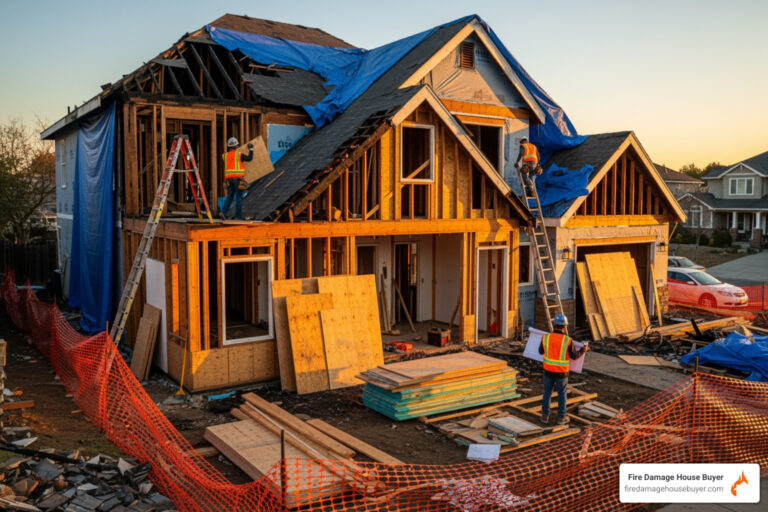
Why Understanding the Rebuilding Process is Critical After a House Fire
Rebuilding a house after a fire involves navigating insurance claims, securing permits, managing contractors, and coordinating multiple phases of restoration—typically taking 6-18 months and costing between $13,404 to over $50,000 depending on damage severity.
Key Steps for Rebuilding After a Fire:
- Secure the property – Board windows, tarp the roof, and prevent unauthorized access
- Document all damage – Take extensive photos and videos for your insurance claim
- File your insurance claim – Contact your provider within 24-48 hours
- Hire professionals – Get structural engineers, contractors, and possibly a public adjuster
- Obtain permits – Steer local building codes and secure necessary approvals
- Complete restoration – Address structural repairs, smoke/soot removal, and water damage
- Final inspections – Ensure all work meets current building code requirements
Over 350,000 American families face house fires annually, and the aftermath is overwhelming. Beyond visible destruction, you’ll confront hidden dangers like toxic chemicals, compromised structural integrity, and a maze of insurance paperwork. The path to recovery is rarely straightforward. Repairs for moderate damage average $13,404, but significant structural issues can easily exceed $50,000. This doesn’t account for the months—or even over a year—spent managing contractors and living in temporary housing.
The rebuilding journey tests your patience and finances, demanding difficult decisions. Do you repair or rebuild? Can you trust the foundation? Will insurance cover the full cost? Beyond the financial strain is a heavy emotional toll. The stress of displacement, grief over lost possessions, and exhaustion from managing the project can strain any family, leaving many feeling trapped by a property that demands constant attention and energy.
This guide walks you through every critical phase of rebuilding a house after a fire, from the chaotic first 48 hours to the final inspection. You’ll learn what to expect from your insurance company, how to identify hidden damage, when to hire specialists, and what the actual costs and timelines look like based on real-world data. We’ll also address the health risks, legal requirements, and emotional challenges that most guides gloss over.
I’m Daniel Cabrera. For 15 years, I’ve helped homeowners steer fire damage recovery. At Fire Damage House Buyer, I’ve seen how rebuilding can become an endless cycle of stress and expense, which is why many families ultimately choose a different path.
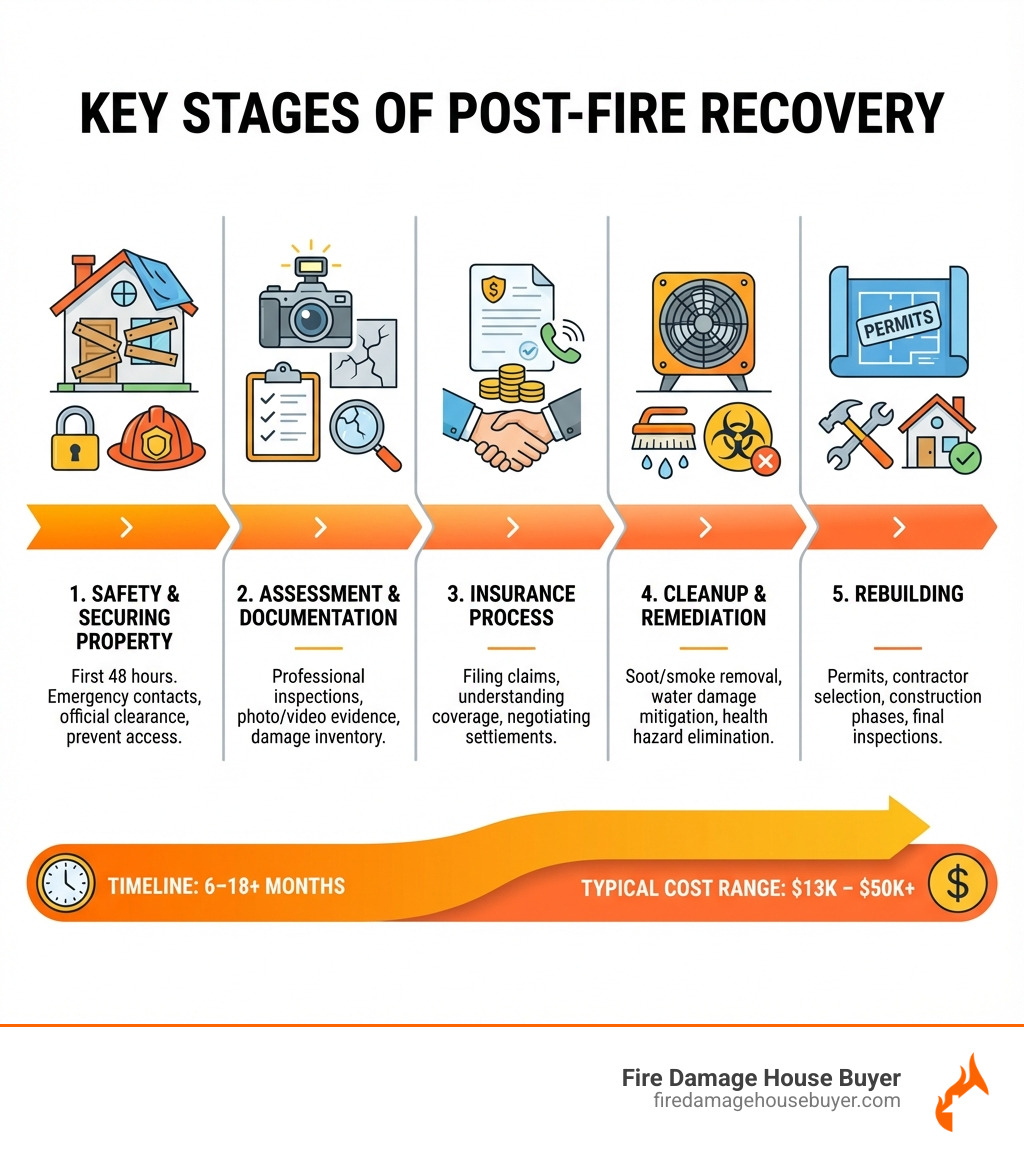
Infographic showing the key stages of post-fire recovery: Safety & Securing, Assessment & Documentation, Insurance, Cleanup & Remediation, and Rebuilding. The process can take 6-18+ months and cost $13,000 to $50,000+.
The First 48 Hours: Immediate Steps and Securing Your Property
The moments immediately following a house fire are a whirlwind of emotions and urgent decisions. While the fire department is on the scene, their primary concern is extinguishing the flames and ensuring everyone’s safety. Once they’ve given the all-clear, your focus shifts to what comes next. Knowing what to do after a house fire will significantly reduce stress, financial pressure, and potential harm.
Your first priority should always be safety. Stay out of your home until fire officials declare it safe to enter. There may be hidden hot spots, structural weaknesses, or hazardous materials present. Find temporary shelter with family, friends, or through assistance organizations like the American Red Cross. Don’t forget to notify your employer and contact close family members to let them know you’re safe.
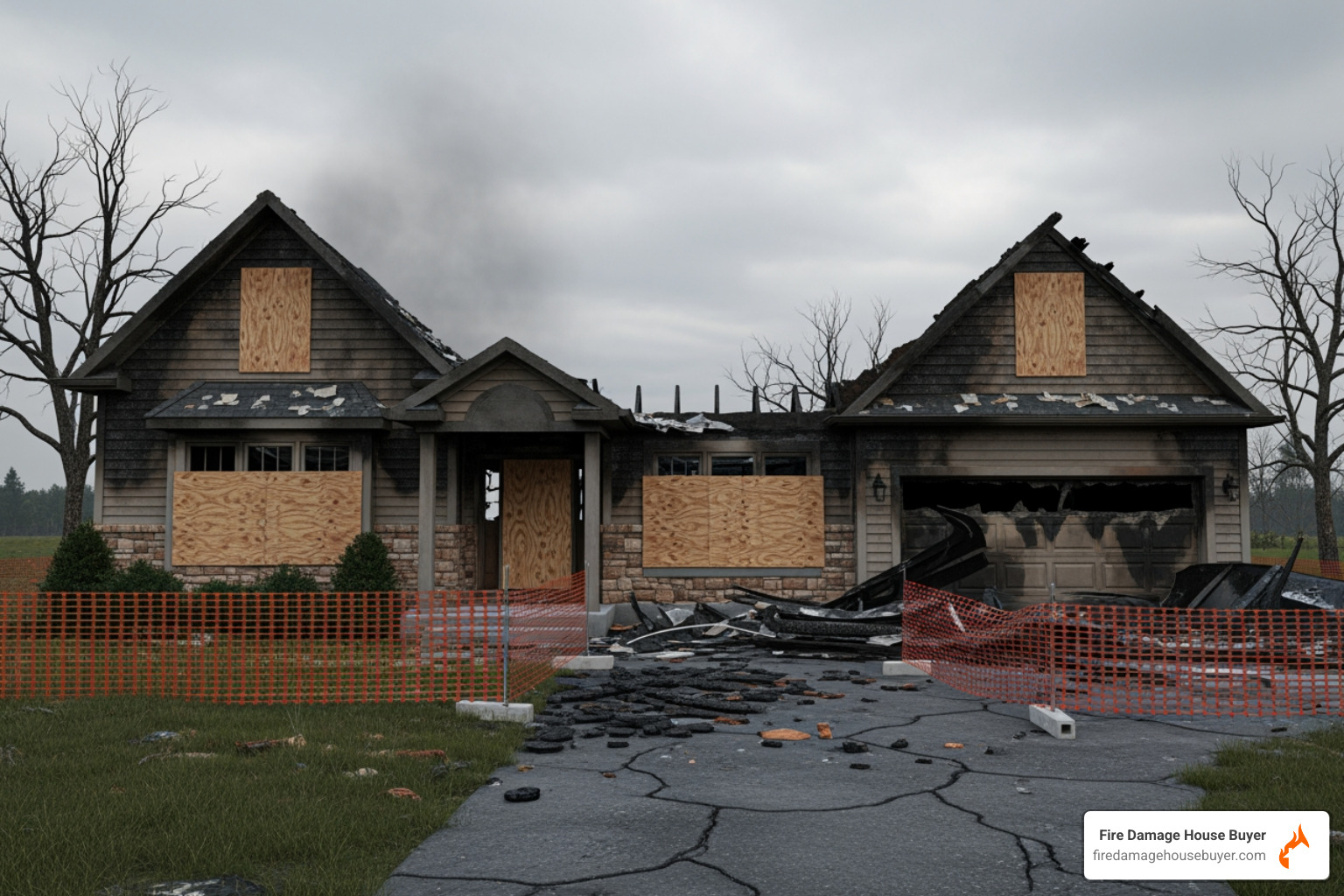
Next, you need to secure the property to prevent further damage or unauthorized access. This often means boarding up broken windows and doors, and tarping any holes in the roof. These immediate protective measures are crucial to protect against weather elements and deter trespassers. Remember to contact your utility providers (gas, electricity, water) to ensure they are safely turned off before anyone enters the property. You’ll also want to request a copy of the official fire report, which will be vital for your insurance claim.
For more detailed guidance on these critical first steps, refer to our comprehensive article: What to do after a house fire. Additionally, resources like Ready.gov provide essential Guidance on returning home safely.
Is It Safe to Re-Enter Your Home?
This is perhaps the most crucial question in the immediate aftermath. The answer, almost universally, is no, not without official clearance. Fire officials will assess the property for structural instability, hidden hot spots that could re-ignite, and immediate dangers like exposed electrical wires or leaking gas lines. Even if the visible damage seems minimal, intense heat can compromise structural components like foundations, framing, and roof systems, making them unsafe.
Beyond structural concerns, the air quality can be severely compromised. Smoke and soot residues contain toxic chemicals that pose significant health risks. Entering without proper protective gear and clearance can lead to respiratory issues, skin irritation, and long-term health problems. Before considering any entry, ensure you have explicit permission from the fire department or a certified structural engineer. For a deeper dive into this, check out: Is it safe to stay in a house after a fire?.
Initial Financial and Logistical Tasks
While your physical safety is paramount, addressing initial financial and logistical tasks swiftly can prevent further stress down the line. One of the first calls, after notifying emergency services and loved ones, should be to your mortgage lender. Even if your house burned down, your mortgage payment obligations continue. Some insurance policies may cover mortgage payments during reconstruction, but understand your specific situation. Our article What happens to your mortgage if your house burns down offers more insights into this often-overlooked aspect.
Next, start a detailed claims file. This file will be your central hub for all documentation related to the fire. Keep every receipt for temporary housing, emergency repairs, and essential items. Your insurance company will require thorough documentation, and being organized from the start will make the process much smoother.
Navigating Damage Assessment and Insurance Claims
Once the immediate crisis has passed, the daunting task of assessing the damage and dealing with your insurance company begins. This phase is critical for determining the path forward for rebuilding a house after a fire.
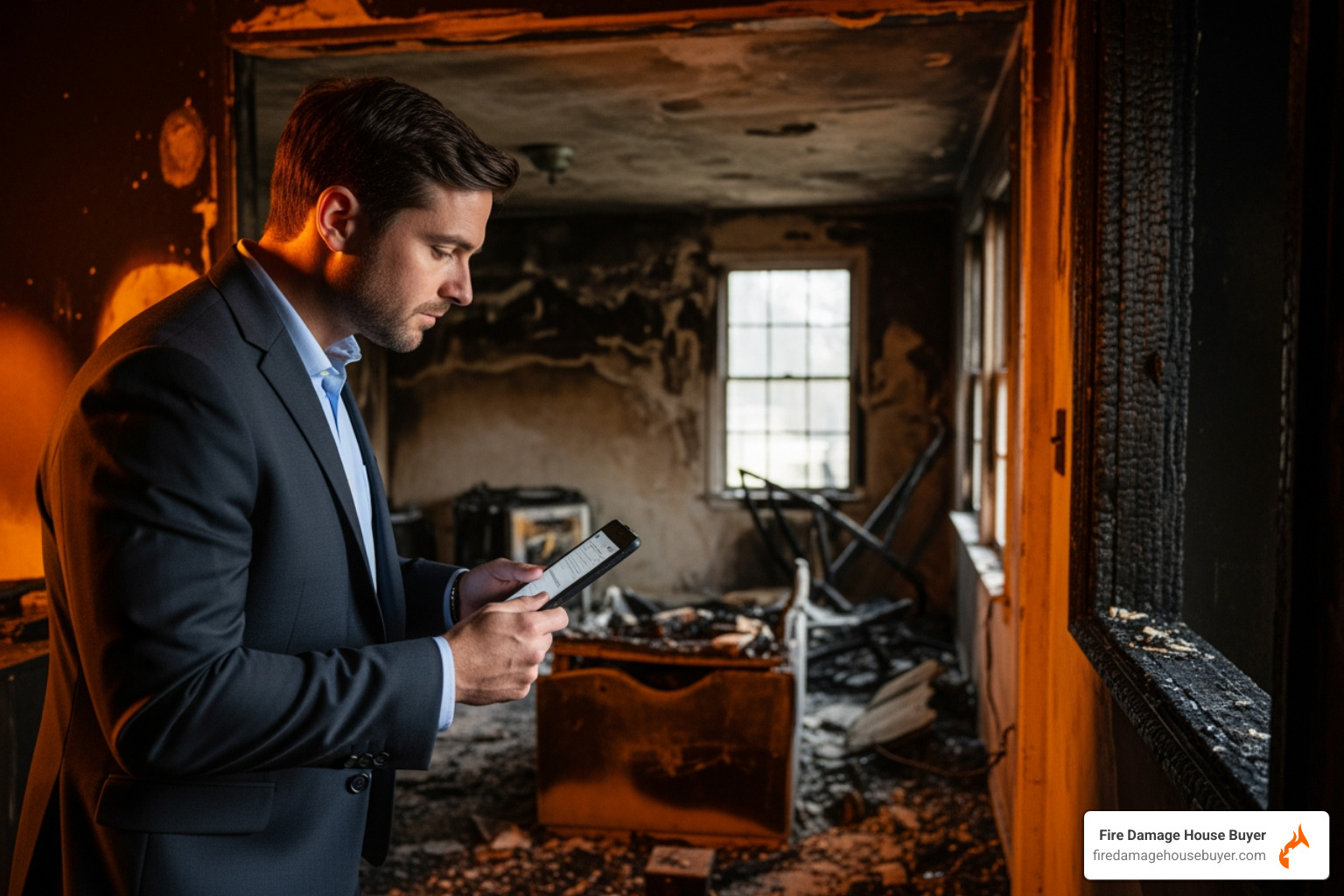
Documenting everything is paramount. Take extensive photos and videos of all damaged areas before any cleanup or repairs begin. This includes the exterior, interior, personal belongings, and any damage from firefighting efforts like water. Create a detailed home inventory list, noting every item lost or damaged, its estimated value, and when it was purchased. This meticulous documentation will be invaluable for your insurance claim.
It’s also important to differentiate between the various types of damage your home might have sustained:
- Fire Damage: Direct burning, charring, and structural compromise.
- Smoke Damage: Residue and odor that penetrates porous materials, often far from the fire’s origin.
- Soot Damage: Oily, acidic particles that coat surfaces, causing discoloration and corrosion.
- Water Damage: From firefighting efforts, leading to potential mold and structural issues.
- Chemical Damage: From burned synthetic materials, which can release toxic substances.
Understanding these distinctions helps in accurately assessing the scope of loss and communicating effectively with your insurance provider. For guidance on valuing your property post-fire, read: Determining the value of a fire-damaged house.
Understanding Your Homeowners Insurance Policy
Navigating your homeowners insurance policy after a fire can feel like deciphering ancient scrolls. Most home insurance policies do cover fire damage to the building, its contents, and the property. However, every policy is unique, and understanding its specifics is crucial.
Key terms to look for include:
- Actual Cash Value (ACV) vs. Replacement Cost Value (RCV): ACV pays for the depreciated value of your property, while RCV covers the cost to replace it with new items of similar kind and quality, without depreciation. RCV is almost always preferable for rebuilding.
- Policy Limits: The maximum amount your insurer will pay for different categories (e.g., dwelling, personal property).
- Dwelling Coverage: Covers the structure of your home.
- Personal Property Coverage: Covers your belongings.
- Loss of Use (ALE) Coverage: Also known as Additional Living Expenses, this covers costs like temporary housing, meals, and other expenses if your home is uninhabitable.
- Debris Removal Clauses: Specifies coverage for clearing the damaged remnants of your home.
- Code Upgrade Coverage: Crucial for rebuilding, as current building codes may require more expensive materials or construction methods than your original home.
Be aware of policy exclusions and limitations. For example, while standard policies cover fire, they typically do not cover flood damage, which can sometimes occur as a secondary disaster after wildfires. For a detailed breakdown of what your policy might cover, see: Does house insurance cover fire damage?.
The Role of a Public Adjuster
When facing significant fire damage, you’ll inevitably interact with an insurance company adjuster. Their primary loyalty is to the insurance company. This is where a public adjuster can be invaluable. Unlike company adjusters, a public adjuster works exclusively for you, the policyholder.
They are experts in navigating complex claims, understanding policy language, and negotiating a fair settlement. They can help maximize your claim by thoroughly documenting all damages, including those often overlooked, and presenting them to your insurer. This is especially important in states with “Valued Policy” laws, where if repair costs exceed a certain percentage of your home’s insured value, you may be entitled to the full policy limit. For example, in Wisconsin, if the cost to repair exceeds 51% of the home’s insured value, the homeowner is due the policy limit for the dwelling.
Public adjusters can be particularly helpful in resolving disputes over the scope of loss, ensuring that your insurance company doesn’t push for the lowest-cost option that may not fully restore your home. We strongly recommend considering a public adjuster, especially for extensive damage, to ensure you receive the compensation you deserve. For more information on this vital role, visit: The benefits of a public adjuster for fire damage.
The Grueling Cleanup and Restoration Phase
Once the initial assessments are done and insurance claims are underway, the physical work of cleanup and restoration begins. This phase is often more extensive and hazardous than homeowners anticipate.
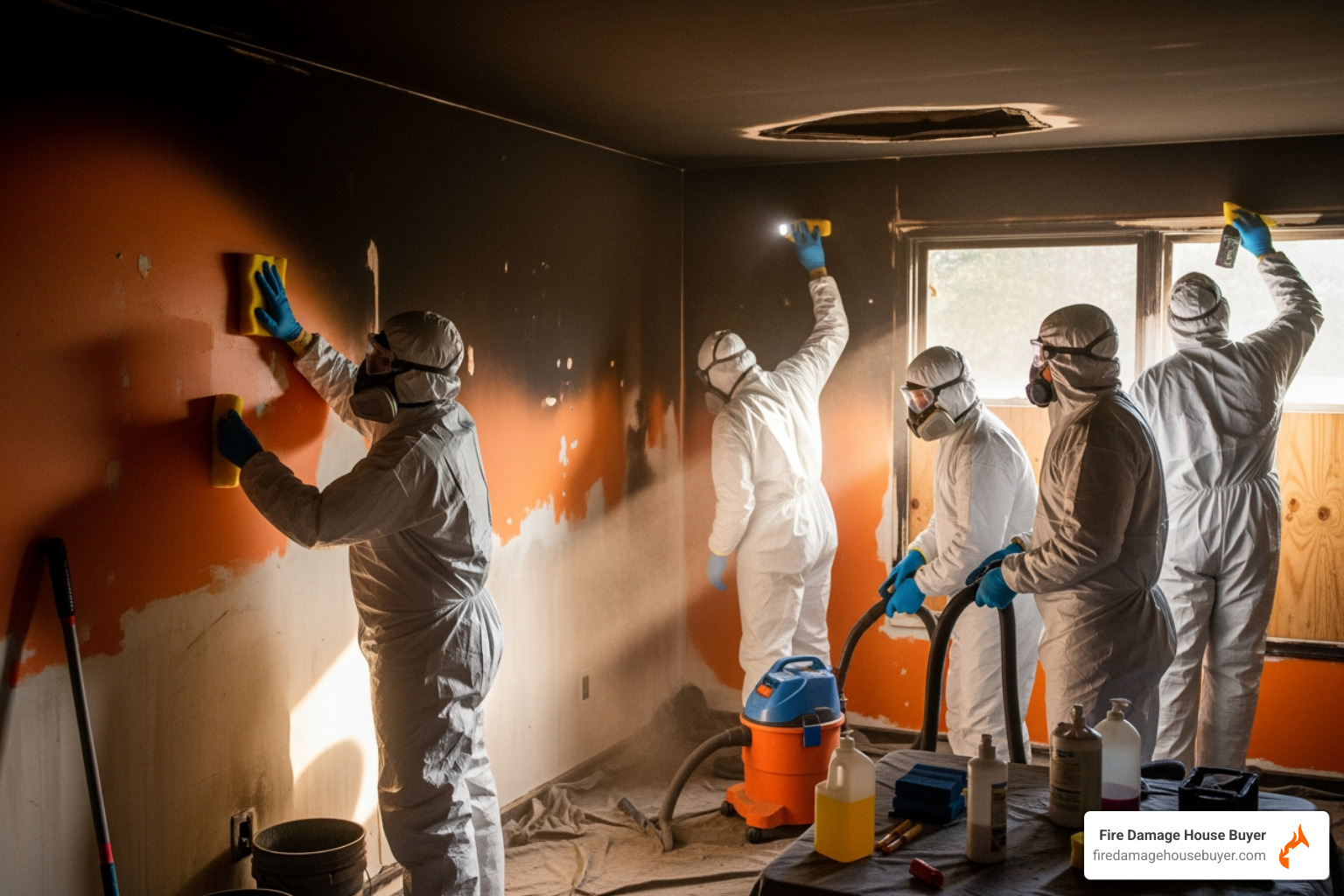
Health Risks and Protective Measures
The aftermath of a fire is not just visually devastating; it’s a hazardous environment. Fire residue contains toxic chemicals that can cause respiratory, skin, or eye issues. Materials like plastics, treated wood, and synthetic fabrics, when burned, release dangerous substances such as hydrogen chloride, dioxins, carbon monoxide, and ammonia. Even seemingly minor smoke damage can leave behind carcinogens. Our brave first responders and firefighters face these risks daily, as highlighted in research on the Health risks our brave first responders and firefighters face.
In older homes (built before 1978), there’s an increased risk of asbestos and lead exposure if these materials were present and disturbed by the fire. We strongly advise against entering the damaged property without appropriate Personal Protective Equipment (PPE), including N-95 respirators, gloves, safety goggles, and protective clothing. For significant damage, professional restoration services are not just a convenience; they are a necessity to ensure safe cleanup and remediation.
Mitigating Water Damage and Mold
Ironically, the efforts to save your home often lead to another significant problem: water damage. Water from firefighting can be as extensive as the fire damage itself, saturating insulation, drywall, flooring, and personal belongings. This creates a prime environment for mold growth, which can start within 24-48 hours.
Prompt mitigation is crucial. This involves:
- Drying the Structure: Industrial fans and dehumidifiers are essential to remove moisture from the air and materials.
- Removing Wet Materials: Saturated drywall, insulation, and carpets must often be removed to prevent mold.
- Sump Pumps: For standing water in basements or lower levels, a sump pump can quickly remove large volumes of water.
- Mold Prevention: Applying antimicrobial treatments to affected areas can inhibit mold growth.
- Mold Remediation: If mold has already taken hold, specialized mold remediation professionals are needed to safely remove it.
Smoke, Soot, and Odor Removal
Smoke and soot are insidious. Soot, whether wet (smeary, from low-heat fires) or dry (powdery, from high-heat fires), can penetrate virtually every surface and crevice. It’s not just an aesthetic issue; soot is corrosive and can cause long-term damage to electronics and metals. The lingering smoke odor can be incredibly difficult to remove and requires specialized techniques.
Professional restoration often involves:
- Specialized Cleaning: HEPA vacuums, chemical sponges, and specific cleaning solutions are used to remove soot without further embedding it.
- Thermal Fogging & Ozone Treatments: These professional methods neutralize smoke odors by breaking down odor-causing molecules.
- Sealing Surfaces: After cleaning, affected surfaces may be sealed with odor-blocking primers.
- HVAC Duct Cleaning: Ash and soot can spread through your heating, ventilation, and air conditioning system, necessitating thorough cleaning or replacement of ductwork and filters.
For more in-depth information on tackling this challenging phase, read our guide: A guide to cleaning up after a house fire. Certified professionals often hold IICRC (Institute of Inspection, Cleaning, and Restoration Certification) credentials, such as WRT (Water Restoration Technician) and FSRT (Fire and Smoke Restoration Technician), indicating their expertise in these complex processes.
Deciding What to Salvage vs. Replace
One of the most emotionally challenging parts of fire recovery is deciding what to keep and what to discard. Many items, even those that appear damaged, can be salvaged with proper cleaning. However, the cost of restoration must be weighed against the replacement cost and the item’s sentimental value.
Here’s a general comparison for common household items:
| Item Type | Salvage Potential (with professional cleaning) | Replacement Often Better If… |
|---|---|---|
| Documents | Yes, if not heavily charred or waterlogged | Heavily burned, water-damaged beyond repair, or easily replaceable |
| Clothing | Yes, if smoke odor can be removed | Severely scorched, melted, or deeply saturated with smoke/soot odor |
| Electronics | Limited (smoke/soot corrosive) | Exposed directly to flames, extreme heat, or corrosive soot |
| Furniture | Non-porous (wood, metal) often salvageable | Upholstered with deep smoke odors, badly charred wood, structural damage |
| Ceramics/Glass | High (non-porous) | Shattered, cracked from heat, or melted |
| Jewelry/Metals | High (non-porous) | Melted, severely tarnished beyond restoration |
| Food/Medicine | No | Always discard, even if packaging appears intact |
| Porous Items | Limited (fabrics, books, soft furnishings) | Deep smoke odor, extensive soot penetration, water damage |
Items like mattresses, heavily smoke-damaged upholstered furniture, and badly charred wooden items are often too expensive to restore effectively. Conversely, jewelry, ceramics, and metal objects typically sustain less damage. For a comprehensive list of what can often be saved, check out: What things can be salvaged after a fire?.
The Complex Path of Rebuilding a House After a Fire
After the cleanup, the real work of rebuilding a house after a fire begins. This is where many homeowners face their biggest decisions: do we rebuild on the existing foundation, or is a complete new construction necessary?
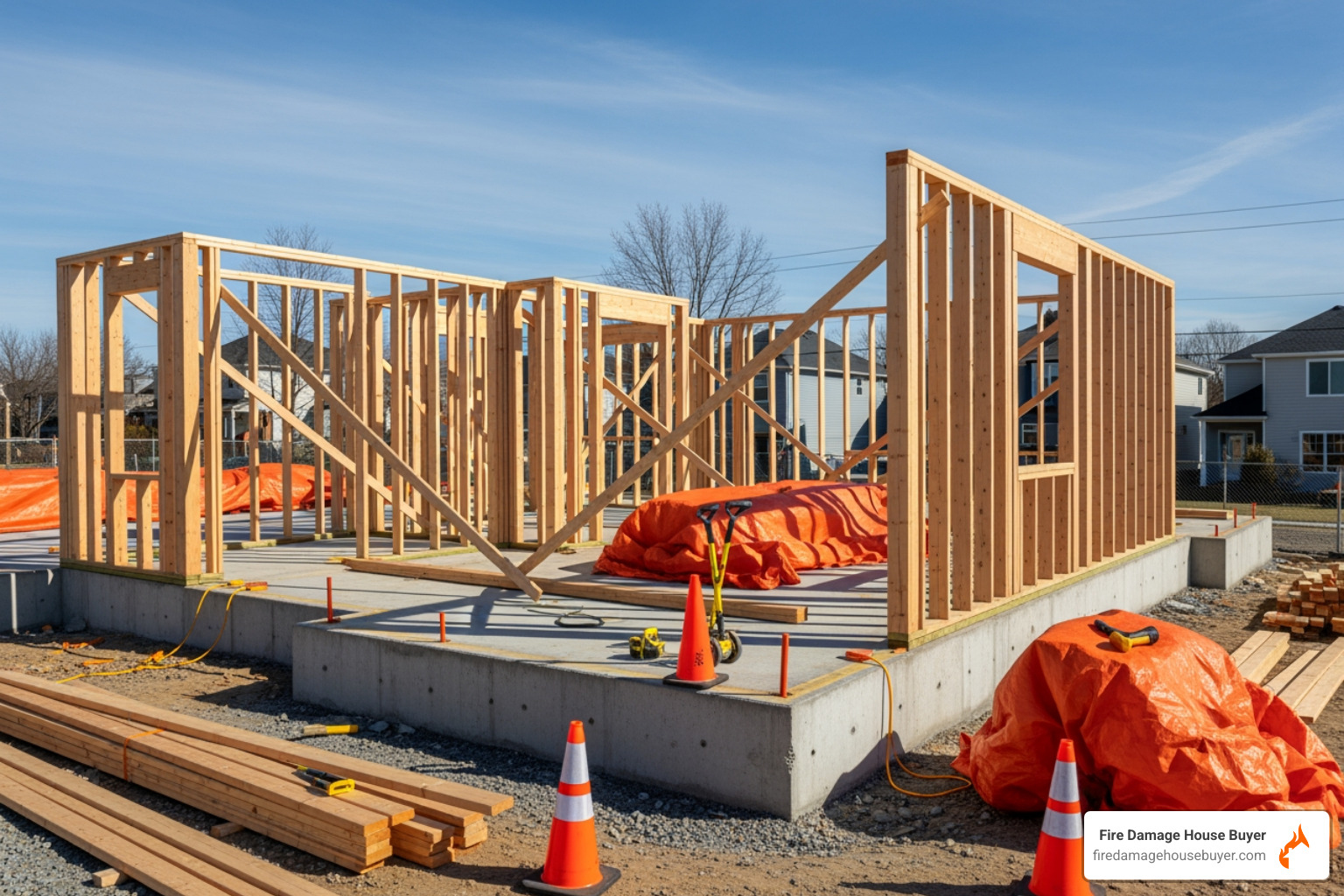
The decision to rebuild versus starting fresh often comes down to the extent of structural damage and cost. If the foundation is sound, rebuilding on it can be more cost-effective than a complete demolition and new build, especially when considering the costs and delays associated with bringing a new construction up to current codes. A structural engineer’s assessment is paramount here. They will evaluate the integrity of your foundation, framing, and other load-bearing elements.
The cost of repairs can vary wildly. While smaller fires might cost $3,000 to $5,000 for repairs, the national average for a full repair is around $13,404. However, fires causing structural damage to roofs, foundations, or destroying a kitchen can easily cost $50,000 and up. For a detailed look at potential expenses, see: The cost to repair a fire-damaged house.
Legal and Logistical Problems: Permits and Codes
Rebuilding isn’t just about hammers and nails; it’s also about paperwork and regulations. You’ll need to steer a maze of local, county, and state requirements.
- Hiring a Licensed Contractor: Always use a state-licensed contractor and insist on a written contract. We recommend verifying their license and insurance.
- Obtaining Building Permits: Permits are required to ensure that all buildings meet minimum standards that protect occupants and neighbors. This applies to states across the country, including Alabama, Alaska, Arizona, Arkansas, California, Colorado, Connecticut, Delaware, Florida, Georgia, Hawaii, Idaho, Illinois, Indiana, Iowa, Kansas, Kentucky, Louisiana, Maine, Maryland, Massachusetts, Michigan, Minnesota, Mississippi, Missouri, Montana, Nebraska, Nevada, New Hampshire, New Jersey, New Mexico, New York, North Carolina, North Dakota, Ohio, Oklahoma, Oregon, Pennsylvania, Rhode Island, South Carolina, South Dakota, Tennessee, Texas, Utah, Vermont, Virginia, Washington, West Virginia, Wisconsin, and Wyoming. You can often submit plans and apply for building permits even before debris removal is complete.
- Local Zoning Laws: Your rebuilt home must comply with current zoning regulations, though some jurisdictions offer allowances for “like-for-like” rebuilds to maintain existing setbacks or footprints.
- Bringing the Structure Up to Current Codes: This is a big one. Rebuilding often means updating electrical, plumbing, and HVAC systems to meet contemporary safety and energy efficiency standards.
- Fire-Resistant Materials and Defensible Space: Especially in wildfire-prone areas like parts of California, Colorado, Oregon, and Washington, rebuilding may necessitate the use of fire-resistant materials for roofing (Class A rated), siding (stucco, fiber cement), and windows (tempered glass). Creating defensible space around your home (a buffer zone free of flammable vegetation) becomes a critical requirement. Chapter 7A of the building code often applies to homes in designated Fire Hazard Severity Zones or Wildland-Urban Interface (WUI) areas, setting minimum standards for wildfire resistance.
The permit process can be lengthy and frustrating, requiring coordination with multiple agencies. Be prepared for this logistical challenge.
The typical process for rebuilding a house after a fire
While every project is unique, the general sequence for rebuilding a house after a fire typically follows these steps:
- Debris Removal and Demolition: This “muck out” phase involves safely clearing all fire-damaged debris and any unsalvageable structural components.
- Foundation Repair or Replacement: Based on the structural engineer’s report, the existing foundation is repaired or a new one is laid.
- Framing and Structural Work: The skeletal structure of the home is erected or repaired, including walls, floors, and roof trusses.
- Roofing and Siding: The exterior shell is made weather-tight with new roofing materials and exterior siding.
- Electrical, Plumbing, and HVAC Installation: All new or repaired utility systems are roughed in within the walls.
- Insulation and Drywall: The interior is insulated, and drywall is installed, taped, and mudded.
- Interior Finishing: This includes flooring, painting, cabinetry, fixtures, and appliances.
- Exterior Finishing: Landscaping, driveways, and other exterior elements are completed.
- Final Inspections: Various municipal inspectors will verify that all work meets current building codes before issuing a Certificate of Occupancy.
This process can involve extensive fire restoration work, including ash, smoke, and soot removal, dehumidification, structural drying, smoke odor neutralization, and air purification. The goal is to remove any trace of fire, make the building structurally sound, restore utilities, and repair, clean, or replace anything affected by the fire to remove toxins, odors, and discoloration.
The Hidden Costs: Emotional Toll and Financial Strain
Beyond the tangible costs of construction and materials, rebuilding a house after a fire extracts a heavy emotional and psychological toll. This is a hidden cost that often goes unacknowledged but can be just as devastating as the physical destruction.
Experiencing a fire is a traumatic event, leading to feelings of shock, sadness, anger, and anxiety. The grief over lost possessions, especially those with sentimental value, can be profound. The stress of displacement, living in temporary housing for months or even years, and constantly battling with insurance companies and contractors can strain even the strongest individuals and families. Many people find themselves feeling lost and overwhelmed, struggling to cope with the immense changes in their lives.
It’s crucial to acknowledge these feelings and seek support. Resources for emotional recovery include:
- Support Groups: Connecting with others who have experienced similar losses can provide invaluable empathy and shared wisdom.
- Mental Health Professionals: Therapists or counselors specializing in trauma can help process grief and develop coping strategies.
- Community Organizations: An array of government, charity, and religious organizations offer assistance and support to fire victims.
The financial strain also extends beyond the direct rebuilding costs. Unexpected expenses, construction delays, and the challenge of managing a budget while displaced can lead to significant financial stress. The constant decision-making and project management demands can lead to burnout.
For a list of organizations and resources that can provide emotional and practical support, please visit: Fire damage resources for support. You don’t have to face this journey alone.
Conclusion: Is Rebuilding Your Best Option?
Rebuilding a house after a fire is an immense undertaking, demanding significant time, money, and emotional resilience. We’ve walked through the immediate aftermath, the complex dance with insurance companies, the grueling cleanup, and the intricate process of reconstruction, from permits to final inspections. We’ve seen that while a national average for repairs might be around $13,404, extensive damage can easily push costs past $50,000, not to mention the hidden health risks and the profound emotional toll.
For many homeowners across our service areas—from the sunny coasts of Florida and California to the snowy plains of Minnesota and the mountains of Colorado—the path to rebuilding is fraught with challenges:
- Lengthy Timelines: Rebuilding can take anywhere from several months to over a year, leaving you in temporary housing and limbo.
- Financial Burdens: Beyond insurance payouts, unexpected costs, code upgrades, and the sheer volume of expenses can drain savings.
- Emotional Exhaustion: The constant stress of managing the project, making decisions, and dealing with loss can be overwhelming.
- Bureaucratic Problems: Navigating permits, inspections, and insurance claims is a complex, time-consuming process.
While some find the strength and resources to rebuild, creating a new dream home from the ashes, many others realize that the burden is too great. The thought of pouring more time, money, and emotional energy into a property that has brought so much heartache can be daunting.
This is why we offer an alternative path to recovery. If the challenges of rebuilding a house after a fire seem too much, you don’t have to face that ordeal. We understand the stress, the delays, and the financial uncertainty.
Instead of starting on a long, complicated, and often frustrating rebuild, you have the option to bypass the entire process. Fire Damage House Buyer offers a fast, fair cash offer for your damaged home, regardless of its condition. No repairs, no cleaning, no commissions, and no waiting for contractors or insurance settlements. We provide a simple, hassle-free way to move forward, allowing you to close quickly and start fresh without the burden of a long, complicated rebuild.
If you’re feeling overwhelmed and ready for a fresh start, consider a simpler solution. Get your no-obligation cash offer today and take the first step towards a new beginning.