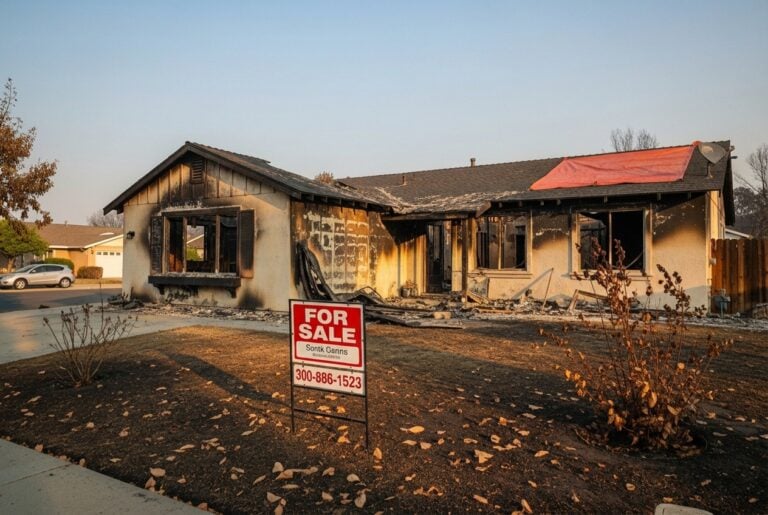
Selling an Inherited Fire-Damaged Home in California: Your Complete Guide
Sell inherited fire damaged house California quickly and without stress by understanding your options and the real numbers behind repair vs. selling as-is. This guide walks through every stage so you can make a confident, informed decision.
Quick Answer: How to Sell Your Inherited Fire-Damaged House in California
- Secure the property – Change locks, board up openings, conduct safety inspections
- Steer probate – Confirm legal authority to sell (typically 9–12+ months in California)
- Contact insurance – File or transfer claims, understand coverage
- Assess repair costs – Fire damage restoration ranges from $25,000 to over $250,000
- Choose your path: Repair first (6–18 months) or sell as-is for cash (7–21 days)
- Understand taxes – Take advantage of stepped-up basis on inherited property
- Disclose properly – California requires clear disclosure of fire damage
Inheriting a fire-damaged house in California combines grief with complex financial and legal challenges. According to CAL FIRE statistics, California sees 7,000–9,000 wildfires annually, with thousands of structures damaged or destroyed each year.
The conventional wisdom suggests fixing the house maximizes value. However, when you factor in repair costs, time, permits, ongoing expenses, and realtor commissions, many heirs find that selling as-is for cash to a specialist like our company often makes more financial sense.
As the founder of Fire Damage House Buyer, I’ve helped California homeowners sell inherited fire damaged house California properties in every condition. This guide combines hands-on experience with practical tips for choosing your best path.
First Steps: Navigating the Aftermath of an Inherited Fire-Damaged House

Inheriting a fire-damaged house in California requires quick, practical steps to secure the property and prevent safety, financial, and legal headaches.
Step 1: Secure the Property and Address Safety
Fire-damaged properties pose serious hazards including compromised structures, exposed wiring, and toxic residue.
Action checklist:
- Change all locks – Prevent unauthorized access
- Board up openings – Secure damaged windows and doors
- Arrange safety inspection – Local building departments can flag immediate hazards
- Turn off unsafe utilities – Shut off gas and electricity if compromised
For a detailed safety list, see our burned house checklist.
Step 2: Confirm Legal Authority
Verify who can legally make decisions and sign sale agreements:
- Locate will or trust documents naming executor or successor trustee
- Obtain death certificates for courts, insurers, and title companies
- Check title holding – Trust, joint ownership, or sole ownership determines probate needs
Properties in living trusts or with right of survivorship may avoid probate. Sole ownership typically requires California probate.
The California Probate Process
Probate validates wills, pays debts, and distributes assets:
- Timeline: 9–12+ months typically
- Executor duties: Managing insurance, taxes, and property maintenance
- Ongoing costs: Property taxes, insurance, and security
Many estates prefer fast cash sales to stop financial bleeding. See what happens after house fire for probate coordination details.
Step 3: Insurance Claims
Insurance often determines financial outcomes. Key concepts:
- Actual Cash Value (ACV): Depreciated value payment
- Replacement Cost Value (RCV): Full replacement cost (often requires completed repairs)
Tips:
- Notify insurer immediately
- Document everything with photos and videos
- Attend adjuster visits
- Don’t cancel prematurely
- Review releases carefully
See our fire claims adjuster guide for process details.
Many heirs can collect insurance payouts AND sell as-is for cash, depending on policy terms.
The Financial Realities: Costs, Value, and Taxes
Understanding the true financial picture helps you compare repair costs against as-is cash sales.
How Fire Damage Affects Market Value
Property value depends on location, damage extent, home age, and buyer perception. Typical California impacts:
- Light damage: 15–35% value reduction
- Moderate damage: 30–60% reduction
- Severe damage: Structure may have near-zero value
Damage extends beyond visible areas. Our guide on what does smoke damage do explains how smoke penetrates walls, corrodes components, and leaves persistent odors. Water damage from firefighting creates additional mold and foundation issues.
For value estimation strategies, see determine value fire damaged house.
Realistic California Repair Costs
California’s high labor costs and strict codes make repairs expensive:
- Minor damage: $10,000–$40,000
- Moderate damage: $40,000–$120,000
- Major damage: $120,000–$250,000+
Common repair costs:
- Structural repairs: $50,000–$150,000+
- Roof replacement: $12,000–$30,000+
- Electrical rewire: $10,000–$30,000
- Plumbing: $5,000–$25,000+
- Smoke remediation: $5,000–$25,000 (see can you clean smoke damage yourself)
- Debris removal: Up to $30,000+
- Permits: $5,000–$20,000+
Example Comparison
Consider a $900,000 pre-fire Los Angeles home:
- Post-fire as-is value: $450,000–$500,000
- Repair costs: $250,000–$300,000
Repairing and selling:
- Sale price: $900,000–$950,000
- Less repairs: -$250,000–$300,000
- Less holding costs: -$20,000–$40,000
- Less commissions (7–8%): -$63,000–$76,000
- Net: $530,000–$600,000
Selling as-is for cash: $475,000–$525,000
- No repair risk
- No permits or contractors
- No carrying costs
- No commissions
Many heirs find the $25,000–$75,000 difference isn’t worth 12–18 months of stress. Use our price fire damaged house calculator for your comparison.
Tax Implications
Inherited fire-damaged homes get special tax benefits:
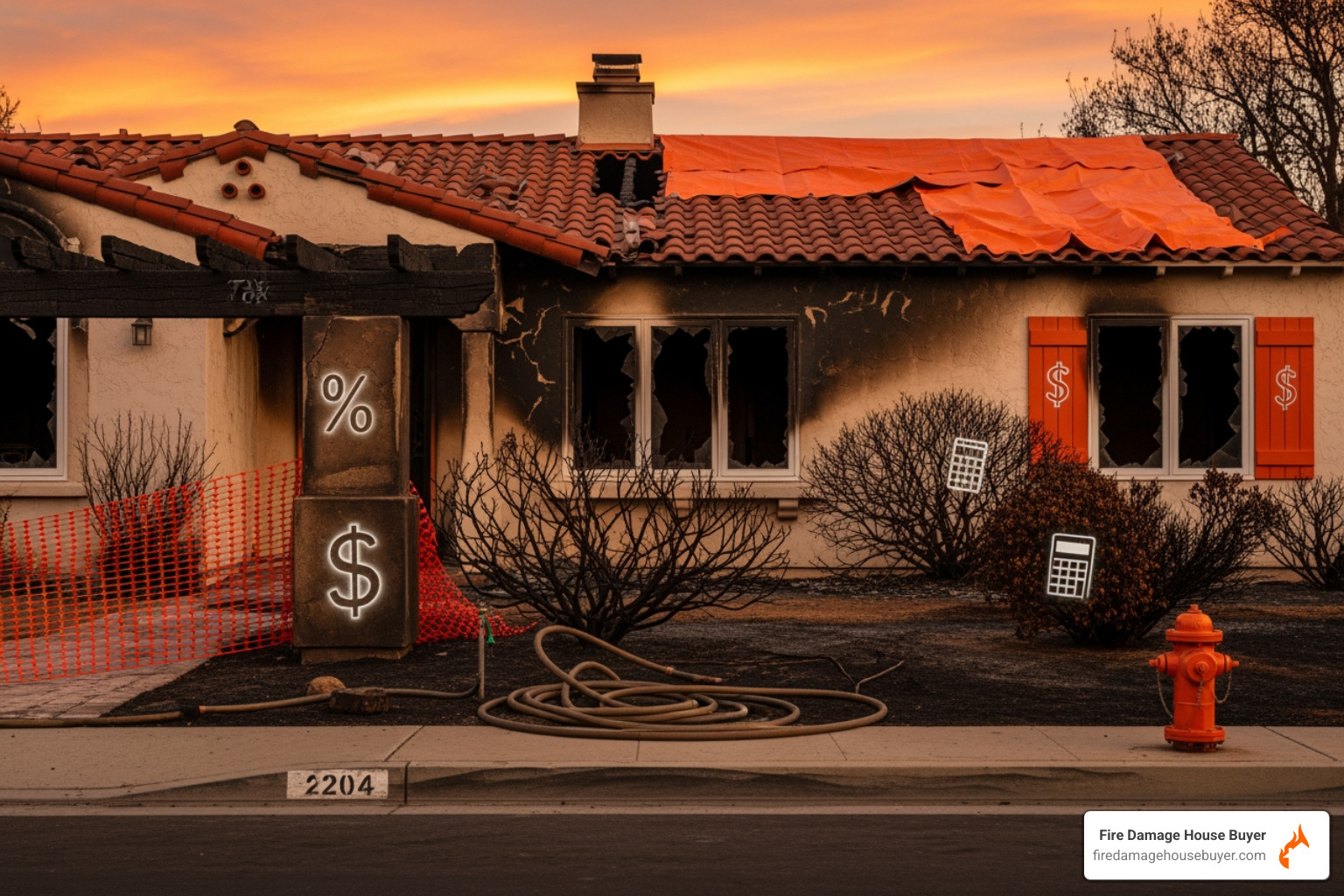
- Stepped-up basis: Property basis increases to death-date value
- Capital gains: Only taxed on appreciation after inheritance
- No California inheritance tax
Example: Parent bought for $150,000, worth $800,000 at death, you sell for $780,000 = potential capital loss, not gain.
Fire damage reducing death-date value further lowers tax exposure. Consult tax professionals, but as-is cash sales are often tax-efficient.
The Big Decision: Repairing vs. Selling Your Inherited House As-Is
Once the dust settles after a fire, you face a pivotal decision: do you repair the damage and then sell the home, or sell it “as is” right now? This decision affects your finances, timeline, and stress level for the next year or more.
Option 1: The Pros and Cons of Repairing Before Selling
Repairing can make sense if:
- You plan to live in the home long-term after repairs.
- You have substantial insurance and cash reserves.
- You’re prepared for months of project management.
Pros of Repairing:
- Higher potential market value: A fully restored home appeals to the broadest buyer pool, including FHA/VA and conventional mortgage buyers.
- Easier buyer financing: Lenders typically won’t finance severely damaged homes, but they will finance renovated, code-compliant properties.
- Personal attachment: Some families feel emotional closure from restoring a long-time family home.
Cons of Repairing:
- High upfront and ongoing costs: Restoration in California often runs $25,000 to $150,000+, and full rebuilds can exceed $250,000.
- Long timeline: Reconstruction and inspections can take 6–18 months, especially when multiple permits and inspections are required.
- Complex contractor management: You must manage bids, schedules, change orders, and quality control—time-consuming even for experienced investors.
- Risk of overruns: Hidden damage (mold, structural, asbestos) can explode your budget.
- Uncertain market conditions: By the time you finish, interest rates or local prices may have shifted.
Our in-depth article on fire damage restoration repair further explains typical scopes of work and where projects commonly go over budget.
Option 2: The Pros and Cons of Selling As-Is
Selling “as is” means you sell the house in its current condition. You do not make repairs, upgrades, or cosmetic improvements—and you price and market it accordingly.
You can attempt an as-is sale via:
- The traditional MLS with a real estate agent, or
- A direct cash sale to a professional buyer like our company.
For fire-damaged properties, a direct cash sale is usually the smoother option.
Pros of Selling As-Is for Cash to Our Company:
- Fast sale and closing: We can often close in 7–21 days after clear title and, if needed, court approval.
- Zero repair costs: You avoid restoration expenses that could easily top $100,000.
- No showings or open houses: You don’t have to repeatedly let strangers tour a damaged property.
- No realtor commissions: When you sell directly to us, you avoid the typical 5–6% agent commission.
- We cover standard closing costs: We generally pay typical closing costs, saving you thousands.
- Certainty of sale: Because we use our own funds, there are no bank loan denials or financing contingencies.
- No cleaning or junk removal: You can leave the property exactly as-is—including debris, damaged furniture, and personal items you don’t want.
See our guide on how to sell house needs work for a broader look at why as-is cash sales often make sense, especially with serious damage.
Cons of Selling As-Is:
- Lower gross sale price: The headline sale price will usually be lower than that of a fully renovated home.
- Smaller buyer pool (if listed traditionally): Only investors and experienced buyers typically pursue severe fire-damage projects via the MLS.
However, when you compare net proceeds—after subtracting repairs, time, holding costs, and commissions—the difference between repairing-and-selling vs. selling as-is for cash is often modest. For many heirs, the simplicity and speed of an as-is cash sale is worth far more than the possibility of a slightly higher net after a year of work.
How to Decide What’s Right for You
When helping families sell inherited fire damaged house California properties, we suggest asking yourself:
- Do you have the cash or credit to fund repairs and contingencies?
- Do you have the time and energy to manage a long project?
- Are you comfortable with risk and market uncertainty?
- Is anyone in the family planning to live in the house after repairs?
If the answer to most of these questions is no, selling the property as-is for cash to our company is usually the best path. You convert a stressful, damaged asset into liquid funds and can focus on what matters most to you and your family.
The Smartest Strategy: Selling to a Cash Buyer
For many heirs, selling to a specialized cash buyer offers the simplest path forward.
Why Choose a Specialized Cash Buyer
We focus specifically on fire-damaged properties, understanding:
- Smoke, soot, and water damage complexities
- California building codes and permits
- Insurance timing and paperwork
- Probate and court-confirmation sales
Using our own capital, we can:
- Make competitive offers based on realistic costs
- Purchase properties others won’t touch
- Coordinate with probate and insurance timelines
Our Simple Process
- Contact Us – Share basic property information
- Property Assessment – Quick evaluation using records, photos, and brief visit
- Fair Cash Offer – Clear, written, no-obligation offer based on as-is value and comparable sales
- Acceptance & Closing – We handle paperwork, coordinate with title companies, and can close in 7–21 days
You don’t need to clean, repair, or remove belongings. Take what you want and leave the rest.
For details, see companies that buy houses for cash and how it works.
How Cash Buyers Expedite Sales
- No financing contingencies – Banks won’t finance severe damage
- Simplified inspections – One due-diligence visit, no repair requests
- Paperwork assistance – Purchase agreements, title work, probate coordination
- Flexible closing – Fast as 7 days or delayed for court approval
While not legally required, consider consulting an attorney. See do i need a lawyer if i sell my house for cash.
Why Our Company Is Your Best Option
Compared to other routes:
- No contractor management
- No marketing or showings
- No inspection surprises
- No mortgage uncertainties
We turn difficult situations into simple, respectful transactions, providing clear options without pressure.
Navigating Legal Disclosures and Common Challenges
Even when selling as-is to a cash buyer, California law imposes certain responsibilities on sellers, including heirs. Understanding these obligations—and common hurdles—helps you avoid surprises and protect yourself.
California Disclosure Requirements
California is known for having some of the strictest real estate disclosure laws in the country. When you sell inherited fire damaged house California as-is, you must still:
- Disclose all known material facts that could affect the property’s value or desirability.
- Be honest about past fires, smoke damage, repairs, and insurance claims.
Key forms and concepts:
- Transfer Disclosure Statement (TDS): This standard form asks about the condition of various systems and features of the home.
- Exemptions for certain estates: Heirs who have never lived in the property may be exempt from some detailed disclosures, but must still reveal what they do know (for example, that a recent fire occurred).
Failing to disclose known issues can lead to legal liability later, even in an as-is sale. When you sell directly to us, our contracts and process are structured to:
- Ensure material facts (like fire damage) are clearly stated.
- Reduce the risk of misunderstandings.
- Give you peace of mind that you won’t be dragged into a dispute after closing.
Common Problems and How to Overcome Them
Selling an inherited fire-damaged house often comes with additional complexities. These are some of the most common—and how selling as-is for cash to our company can help.
1. Dealing with Tenants or Occupants
If the property was rented or occupied at the time of the fire:
- California’s strong tenant protections may require specific notices or relocation assistance.
- If the unit is declared uninhabitable, certain obligations may arise.
An experienced cash buyer can:
- Purchase the property with tenants in place, taking on the responsibility of working with them.
- Help coordinate timelines so occupants have reasonable time to move.
2. Navigating Family Disputes
Family members often disagree about whether to repair, live in, or sell a damaged inherited home.
Benefits of a cash sale in this situation:
- Clear, concrete number: Our cash offer provides a real figure everyone can evaluate.
- Fast resolution: Instead of arguing for months while the property deteriorates, the estate can quickly convert it into funds that are easily divided.
- Neutral third party: We deal with the authorized executor or trustee, following the will, trust, or court instructions.
3. Avoiding “Quick Sale” Scams
Distressed properties attract opportunists who:
- Make unrealistically high verbal offers, then renegotiate at the last minute.
- Use confusing contracts with hidden fees or long inspection periods.
- Pressure you to sign immediately.
To protect yourself:
- Research any buyer’s track record and reviews.
- Insist on clear, written offers.
- Ask who is actually buying the property (end buyer vs. wholesaler).
- Consult your attorney or advisor if you’re unsure.
We encourage you to compare our offer and process with others. We’re transparent about our numbers and welcome your questions.
4. Understanding the Contract
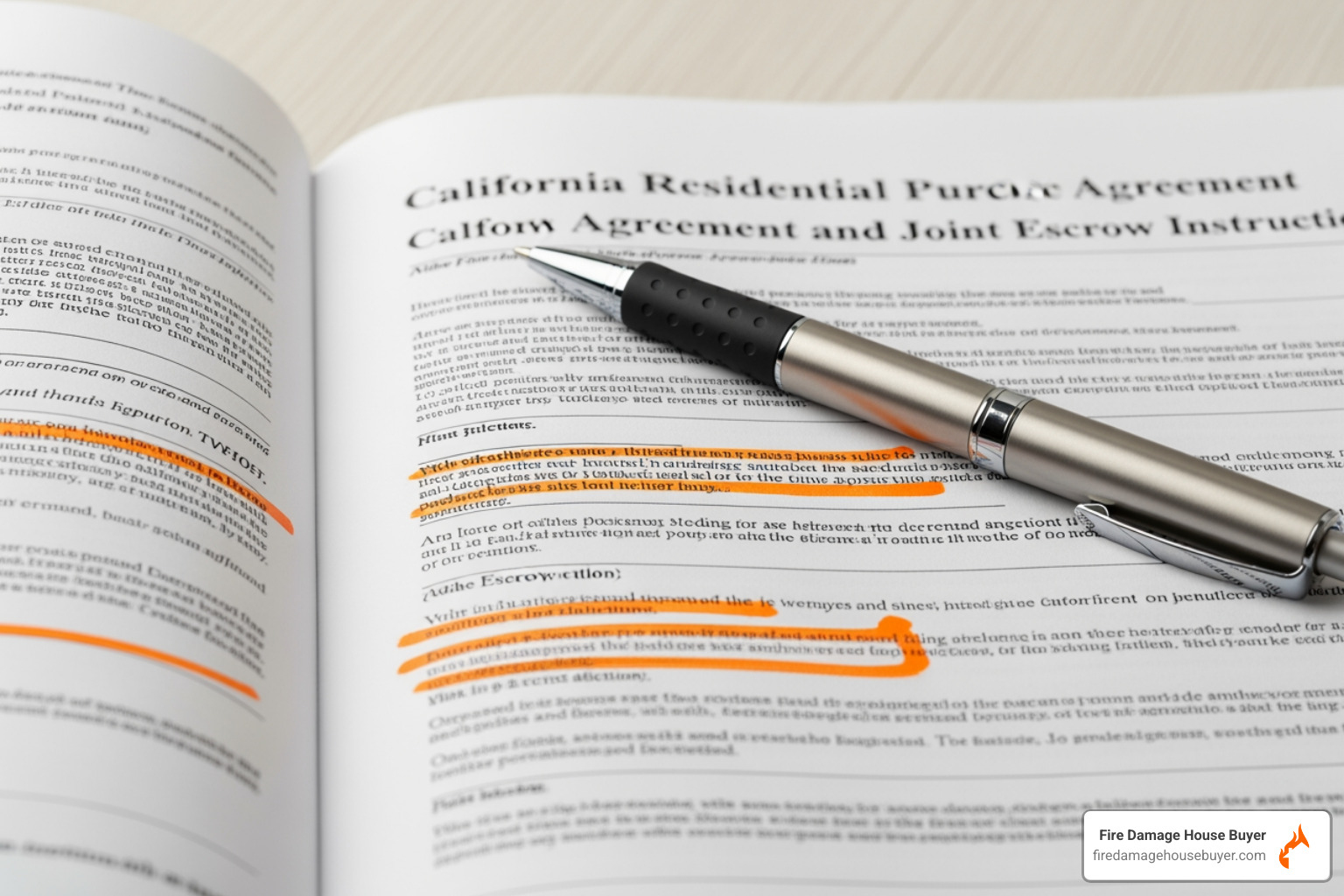
Whether you list with an agent or sell directly to a cash buyer, review the purchase agreement closely. Focus on:
- As-is clause: It should clearly state that the property is sold in its current condition.
- Contingencies: Fewer contingencies mean less opportunity for the buyer to back out.
- Closing costs: Confirm who pays what.
- Closing date: Ensure it matches your needs and any probate timelines.
We use straightforward, plain-English contracts and walk you through each section so you know exactly what you’re signing.
Frequently Asked Questions about Selling an Inherited Fire-Damaged House
Here are detailed answers to common questions we receive when helping heirs sell inherited fire damaged house California.
Can I sell an inherited fire-damaged house during probate in California?
Yes, you generally can—but the sale must follow probate rules.
- The executor or administrator petitions the court for authority to sell the property.
- Depending on the level of authority granted (full vs. limited), the sale may require court confirmation and potentially an overbid process.
- Appraisals and proper notice to heirs are typically required.
This can extend the overall timeline, but a cash buyer with experience in probate sales is often preferred by courts and attorneys because:
- The offer is not contingent on financing.
- The buyer is willing to wait for court dates.
- The likelihood of the sale falling through is very low.
We routinely coordinate with probate attorneys and can structure our offer to comply with the specific requirements of your county court.
Do I have to pay capital gains tax on an inherited fire-damaged house?
Often, no or very little, especially if you sell relatively soon after inheriting.
Because of the stepped-up basis, you’re usually taxed only on any appreciation after the date of death valuation. If the house’s value declined because of the fire or you sell it close to that value, your taxable gain may be minimal or even negative.
Still, personal circumstances vary, so we always recommend speaking with a tax professional for precise guidance.
Can I keep the insurance money if I sell the house as-is?
In many cases, yes. Typically:
- If the policyholder (or estate) receives an insurance payout for fire damage,
- And you decide not to rebuild or repair,
- You may still keep the funds and sell the damaged property as-is.
However, some policies include provisions that:
- Encourage or require using funds for repairs to receive the full Replacement Cost Value (RCV).
- Limit certain coverages if the property won’t be rebuilt.
Always review your policy carefully and consult with the claims representative and, if needed, an attorney. From a property-buying standpoint, we can make a fair as-is cash offer regardless of your insurance situation.
What if the city has red-tagged the property or cited it for code violations?
Fire-damaged homes are sometimes:
- Red- or yellow-tagged as unsafe.
- Subject to code enforcement notices or deadlines.
While this can seem alarming, we regularly purchase properties in this condition. We will:
- Review the city’s documentation.
- Factor any required demolition or repairs into our offer.
- Take over responsibility for working with the city after closing.
You avoid fighting with code enforcement yourself and can walk away from the problem entirely.
Do I need to clean out the property before selling?
No—not when you sell directly to us.
- You can take the personal items you want to keep.
- Leave behind damaged furniture, appliances, debris, and trash.
- We handle the full clean-out and any necessary demolition.
This is especially helpful for out-of-state heirs or those dealing with a large volume of belongings.
Will you still buy my house if it’s only partially damaged?
Absolutely. We buy:
- Houses with light smoke damage.
- Properties with one-room or kitchen fires.
- Homes with extensive structural and roof damage.
- Lots where the structure is a total loss and only the land has value.
If the property has any level of fire-related damage and you’re considering selling, we’re interested in making a no-obligation cash offer.
Conclusion
Selling an inherited fire-damaged house in California presents unique challenges combining safety concerns, insurance claims, probate, and substantial repair costs.
Key takeaways:
- Secure the property first and understand your legal position through probate
- California repair costs are substantial – often $25,000 to $250,000+ with 6–18 month timelines
- Fire damage extends beyond visible areas through smoke, soot, water, and required code upgrades
- Stepped-up basis minimizes capital gains tax on inherited property
- After accounting for all costs, repairing before selling often provides minimal net advantage
- Selling as-is for cash to our company offers:
- Fast closing in 7–21 days
- No repairs, cleaning, or showings
- No commissions or closing costs
- Certainty during difficult times
Rather than spending a year rebuilding a property you never planned to inhabit, convert it to cash quickly and predictably.
According to the California Association of Realtors, cash transactions now represent a significant portion of California real estate sales, particularly for properties requiring substantial work. This trend reflects the growing recognition that traditional sales aren’t always optimal for damaged properties.
If you’re ready to explore this option, visit Sell Fire Damaged House to request a no-obligation cash offer. There’s no pressure and no cost to find what your inherited fire-damaged California house is worth today.
When you’re ready, we’re here to help you sell inherited fire damaged house California the simplest way possible – as-is, for cash, on your timeline.